Dental clinics in San Luis Río Colorado, Mexico operate under federal Mexican health regulations — primarily the official standard NOM-013-SSA2-2015 and oversight by COFEPRIS, Mexico's federal health-risk authority — which require autoclave sterilization of instruments, single-use disposables, and certified biohazard waste handling. On paper, those requirements closely parallel the CDC infection-control guidelines that US dental offices follow. The practical difference for a patient crossing from Yuma is verification: knowing what proper sterilization looks like, observing it in the clinic, and asking a few direct questions before you sit in the chair.
Who Regulates Dental Clinics in San Luis Río Colorado?
Dentistry in Mexico is regulated at the federal level. COFEPRIS (the Federal Commission for Protection against Sanitary Risks) plays a role similar to a combination of the FDA and a state health department in the United States. Every legally operating dental clinic must file a notice of operation with health authorities, and every dentist must hold a cédula profesional — a federal professional license issued after completing an accredited dental degree. Specialists such as implantologists, oral surgeons, and orthodontists can additionally hold specialty credentials for their postgraduate training.
The core clinical standard is NOM-013-SSA2-2015, Mexico's official norm for the prevention and control of oral diseases. It sets out infection-control obligations for dental practices: sterilization of reusable instruments, use of disposable barriers and single-use items where appropriate, personal protective equipment for clinical staff, and hygienic management of the operatory between patients. A separate standard, NOM-087-ECOL-SSA1-2002, governs how clinics must separate, store, and dispose of biological-infectious hazardous waste — sharps, extracted teeth, blood-contaminated materials — through certified handlers.
In short: a properly licensed clinic in San Luis Río Colorado is not operating in a regulatory vacuum. It answers to a federal framework that was written with the same infection-control science used north of the border.
Mexico vs. US Standards: An Honest Comparison
Patients deserve a straight answer here, not marketing. The written standards in both countries are built on the same principles — heat sterilization, disposables, barriers, and waste control. Where the two systems differ most is in how enforcement is carried out and how uniformly it reaches every office.
| Area | Mexico (SLRC clinics) | United States |
|---|---|---|
| Primary oversight | COFEPRIS + federal norms (NOM-013, NOM-087) | CDC guidelines, OSHA rules, state dental boards |
| Instrument sterilization | Autoclave (steam sterilization) required for reusable instruments | Autoclave per CDC infection-control guidelines |
| Sterilization monitoring | Chemical indicators standard; biological (spore) testing at quality-focused clinics | Biological spore testing routinely expected; required by many states |
| Single-use items | Needles, gloves, saliva ejectors, barriers | Same categories of disposables |
| Biohazard waste | Certified collection under NOM-087 | OSHA plus state medical-waste rules |
| Dentist licensing | Federal cédula profesional; specialty cédulas for postgraduate fields | State licensure plus continuing education |
| Enforcement style | COFEPRIS inspections; complaint-driven in practice, so consistency varies clinic to clinic | Board audits and complaint investigations; generally more standardized |
The honest takeaway: the gap between the two countries is not the rulebook — it is the consistency of enforcement. That is exactly why experienced dental travelers do a small amount of verification themselves, and why reputable border clinics go out of their way to show their sterilization process. The good ones treat transparency as a competitive advantage.
What Proper Sterilization Looks Like: What to Observe in the Clinic
You do not need a clinical background to evaluate the basics. When you arrive for your first evaluation, keep your eyes open for these signs of a well-run operatory:
- Sealed sterilization pouches opened in front of you, with a color-change chemical indicator visible on the pouch.
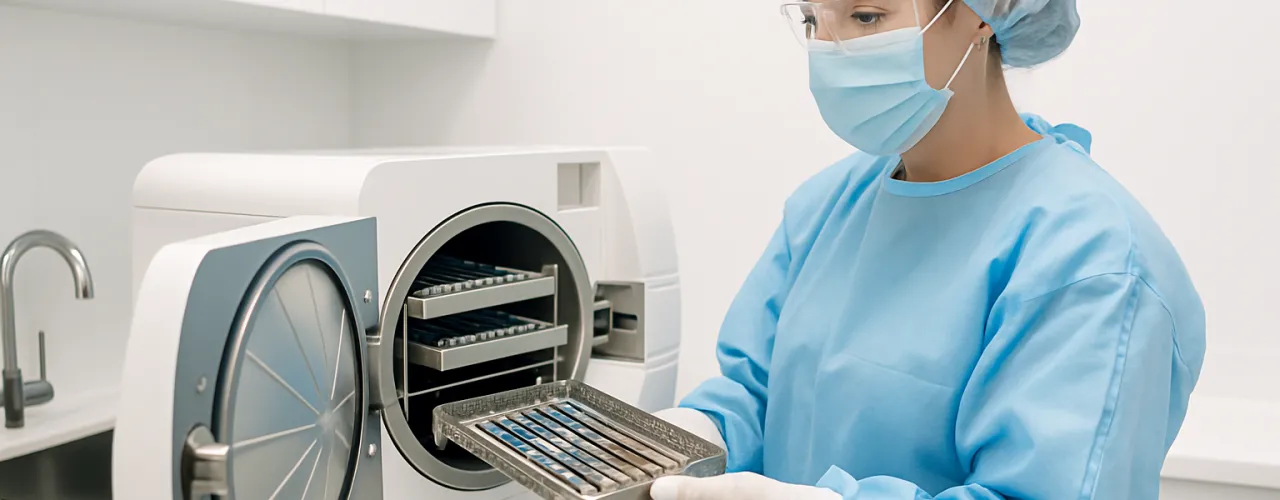
- An autoclave on the premises — many clinics are happy to show you the sterilization room if you ask.
- An ultrasonic cleaner for pre-cleaning instruments before autoclaving.
- Fresh surface barriers (plastic wrap on chair controls, light handles, headrests) changed between patients.
- New gloves and mask put on in front of you, and hand hygiene before gloving.
- Needles and anesthetic cartridges taken from sealed, single-use packaging.
- A generally orderly clinical area — no loose instruments sitting out on open trays.
Questions to Ask Before Treatment
Any quality clinic in San Luis Río Colorado will answer these without hesitation. Evasive or annoyed responses are themselves an answer.
- What sterilization equipment do you use, and may I see the sterilization area?
- How do you monitor your autoclave — do you run biological (spore) tests?
- Will my instruments come from a sealed pouch opened at chairside?
- May I see the dentist's cédula profesional and any specialty credentials?
- Which items in my procedure are single-use?
- How is your biohazard waste handled?
If you want help finding clinics that welcome exactly this kind of scrutiny, start with our directory of dentists in San Luis Río Colorado, or simply Get your free quote and tell us safety documentation matters to you — we will pass that on.
Red Flags That Should Make You Reschedule Elsewhere
- Instruments stored loose on trays or in drawers rather than in sealed pouches.
- No visible autoclave and no willingness to discuss sterilization.
- Staff moving between patients without changing gloves.
- No diploma, license, or cédula displayed and no straight answer when you ask.
- Pressure to start an irreversible procedure the same day, before you have seen X-rays or a written plan.
One red flag deserves a follow-up question; several together deserve a polite exit. With multiple clinics available in the city, you always have the option to walk two blocks and compare.
Does a Lower Price Mean Lower Safety?
No — and it is worth understanding why. Market ranges in San Luis Río Colorado run around $900–$1,500 for a dental implant (versus $2,500–$5,000 in the US) and $400–$500 for a zirconia crown (versus $1,200–$1,800 north of the border), a typical savings of 60–75%. That difference comes from lower labor costs, lower rent, lower administrative and insurance overhead, and Mexico's lower cost of living — not from skipping autoclave cycles. Sterilization supplies are a small fraction of a clinic's costs; no rational clinic saves money there. You can see how the economics play out across procedures in the San Luis Río Colorado dental price list for 2026.
How San Luis Río Colorado Compares to Los Algodones on Safety
Los Algodones remains the world's dental capital, with 300+ clinics concentrated in a few walkable blocks and decades of continuous US and Canadian patient flow. That density of informed, reviewing, returning patients has pushed sterilization and transparency standards in Algodones very high — clinics there live or die by reputation. San Luis Río Colorado offers a different profile: it is a full-sized Mexican city with its own established dental community, typically the fastest border crossing in the region, and the convenience of driving straight to your appointment. If you live near San Luis, Arizona, or simply prefer a quicker crossing, SLRC is the practical choice — and the verification habits described in this article apply identically in both cities. For the broader picture of options close to Yuma, see our guide to finding a dentist in Mexico near Yuma.
Practical Safety Notes for Your Visit
San Luis Río Colorado sits about 25 minutes (23 miles) from Yuma via US-95, through the San Luis I port of entry, which you can cross on foot or by car. Bring a passport or passport card for your return to the United States, and check CBP's official Border Wait Times before you head back. Our step-by-step notes on crossing the San Luis, AZ border for dental care cover documents, timing, and what to expect at the port.
Sterilization standards are not a reason to avoid Mexican border dentistry — they are a reason to choose your clinic deliberately. The regulations exist, the equipment is standard, and the best clinics in San Luis Río Colorado will happily show you both. Verify once, and you can return for years with confidence. Ready to compare vetted options? Get your free quote and we will match you with clinics that put their sterilization process on display.
123 clinics scored on reviews, rating and digital presence. No clinic pays for its position.
- #1 AVA Smile Studio
- #2 Dentista en San Luis Rio Colorado Mexico | Aceptamos Seguro Americano | Ulloa
- #3 OnDent Clinic
Frequently Asked Questions
Are dental clinics in San Luis Río Colorado safe for US patients?
What is COFEPRIS and why is it important?
What should I check before choosing a dentist in San Luis Río Colorado?
Do Mexican dentists use autoclaves for sterilization?
How can I verify a clinic's safety standards before traveling?
Are safety standards in San Luis Río Colorado comparable to the US?
Questions this page answers
- are dentists in San Luis Río Colorado safe
- COFEPRIS dental clinic standards Mexico
- how to check if a Mexican dentist is safe
- sterilization standards in Mexican dental clinics
- San Luis Río Colorado dentist reviews safety
- what to look for in a dental clinic in Mexico
- dental infection control Mexico 2026
- autoclave sterilization dental Mexico
- safe dental tourism San Luis Río Colorado
- Mexican dental regulations for US patients