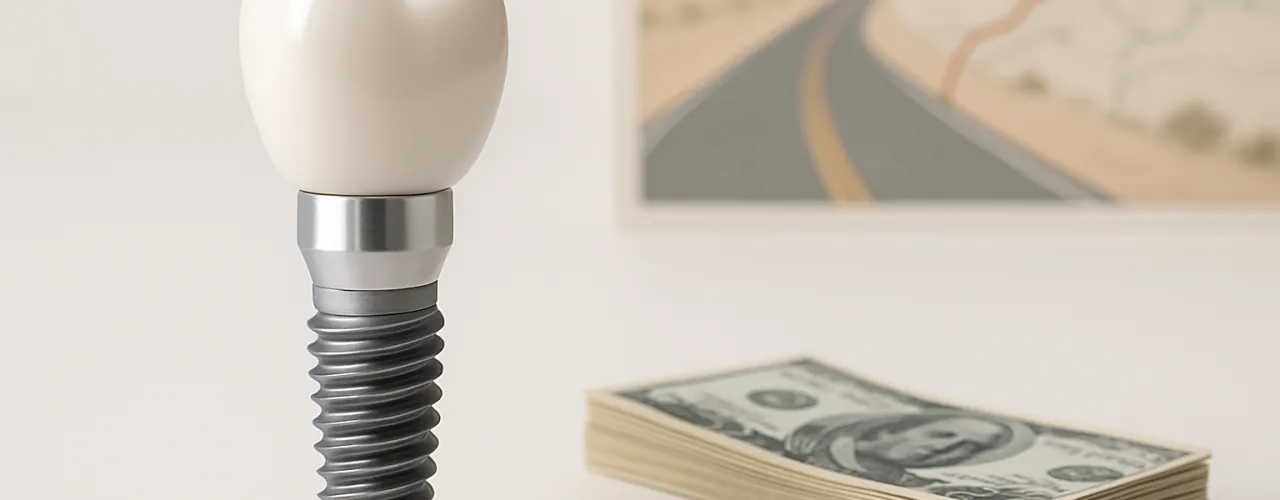
A single dental implant in Mexico near Yuma, Arizona costs $900–$1,500 in 2026, compared with $2,500–$5,000 in the United States — a saving of 60–75%. Full-arch All-on-4 treatment runs $8,000–$12,000 per arch versus $20,000–$30,000 in the U.S. Those border-market ranges apply in both destinations within a short drive of Yuma: Los Algodones (10 minutes west, 300+ clinics) and San Luis Río Colorado (25 minutes south, drive-across border city).
Implant Prices Near Yuma: The 2026 Numbers
Yuma-area patients are in an unusually good position: two Mexican border dental destinations sit within a 25-minute drive, and both price implants in the same competitive border-market band. Los Algodones remains the world's dental capital with 300+ clinics and the deepest bench of implant specialists anywhere on the border; San Luis Río Colorado is a smart alternative if you want shorter border waits, drive-across access in your own car, or you live near San Luis, Arizona. Prices between the two are effectively equivalent — the decision is about experience and specialist depth, not dollars. See the full San Luis Río Colorado vs. Los Algodones comparison for the head-to-head.
One thing to understand before comparing any two quotes: "an implant" is not one price — it is three components, often billed separately.
What "One Implant" Actually Includes: The Three-Part Breakdown
A complete implant-supported tooth has three parts, and clinics quote them in different combinations. This is the single biggest source of confusion when patients compare prices — in Mexico and in the United States alike.
- The implant (fixture): the titanium post surgically placed in the jawbone. This is what the headline "$900–$1,500" border price usually refers to, and what a U.S. clinic bills $2,500–$5,000 for at the surgical stage.
- The abutment: the connector piece screwed into the implant after healing, on which the crown seats. Frequently billed as a separate line item.
- The crown: the visible tooth, typically zirconia or porcelain-fused-to-metal. A zirconia crown runs $400–$500 at the border versus $1,200–$1,800 in the U.S.
When you request quotes, always ask for the all-in price of implant + abutment + crown, in writing. A complete single-tooth restoration at border-market rates typically lands in the ballpark below:
| Component | Border Mexico (market range) | Typical USA price |
|---|---|---|
| Implant fixture (surgical placement) | $900–$1,500 | $2,500–$5,000 |
| Abutment | Often included or a modest separate fee — confirm in writing | Commonly a separate fee of several hundred dollars |
| Zirconia crown | $400–$500 | $1,200–$1,800 |
| Complete single-tooth restoration | Roughly $1,300–$2,000 all-in at market rates | Commonly $3,700–$6,800+ all-in |
| All-on-4 fixed bridge (per arch) | $8,000–$12,000 | $20,000–$30,000 |
Possible add-ons on either side of the border: 3D CT scan, extractions, bone grafting or sinus lift if you lack bone volume, and sedation beyond local anesthesia. A trustworthy clinic identifies these needs at the diagnostic stage and prices them up front — not mid-surgery.
Before you go further, put a real number on your own case: get your free quote via the MolarCity San Luis Río Colorado page — it takes two minutes.
Implant Brands You Will See at the Border
Established border clinics work with the same international implant systems used in U.S. practices. Brands commonly offered in the Yuma-adjacent corridor include Straumann and Nobel Biocare at the premium end, and MIS and Zimmer among widely used mid-tier systems. Which brand suits your case depends on your anatomy, bone quality, and budget — no ethical dentist promises a specific brand before examining you.
Why brands matter: major systems have decades of published clinical data and, critically, globally available replacement parts. If you ever need a new crown or abutment years from now, any dentist in Arizona can source components for a Straumann or Nobel implant. An unnamed economy implant may leave you stranded. Always ask which system the quote is based on, and ask for the implant's documentation card after surgery — reputable clinics provide it as a matter of course.
The Two-Trip Timeline (and Why It Fits Yuma Perfectly)
Standard implant treatment cannot be completed in one visit anywhere in the world, because the implant must fuse with your bone (osseointegration) before it can bear a permanent tooth. The typical schedule:
- Trip 1 — evaluation and placement (1–3 days): exam, X-rays or CT scan, any needed extractions or grafting, and surgical placement of the implant. You leave with sutures and, in visible areas, often a temporary tooth.
- Healing at home (3–6 months): the implant integrates with your jawbone while you live your normal life in Arizona. Simple cases heal faster; grafted sites take longer.
- Trip 2 — restoration (2–5 days): the dentist confirms integration, places the abutment, takes impressions or digital scans, and seats your final crown or bridge.
For fly-in patients, two trips mean two rounds of airfare and hotels. For Yuma-area patients, they mean two short drives — which is why the implant math is better here than almost anywhere else in the country. All-on-4 follows a different rhythm: most clinics place four implants per arch and attach a fixed provisional bridge within days, with the definitive bridge fitted on a second visit months later.
Why the Savings Are Real (Overhead, Not Quality)
A 60–75% discount naturally raises the question: what is being cut? At credentialed border clinics, the honest answer is overhead. Commercial rent in a Mexican border city is a fraction of U.S. rates; clinical staff salaries are far lower; malpractice insurance costs a fraction of U.S. premiums; and clinics run lean administrative operations because most patients pay directly, with no insurance-billing departments. Meanwhile the implant systems, imaging equipment, and lab materials are internationally sourced at broadly similar cost — which is why quoted prices do not drop to zero, and why prices far below the market ranges above deserve suspicion rather than celebration.
Quality, then, is a clinic-level variable, not a country-level one. Protect yourself the same way you would when choosing a U.S. specialist:
- Verify the dentist's degree and implant or oral-surgery training, and confirm the clinic operates under Mexican health-authority (COFEPRIS) regulation.
- Insist on 3D imaging before surgical planning for implant cases.
- Get the full treatment plan — brand, components, add-ons, timeline, warranty terms — in writing before you commit.
- Ask how the clinic handles complications and follow-up once you are back in Arizona.
MolarCity verifies credentials and publishes transparent pricing precisely so this homework is done before you cross the border.
Frequently Asked Questions
How much does a full set of implant teeth cost in Mexico near Yuma?
All-on-4 treatment costs $8,000–$12,000 per arch at border-market rates, so a full mouth (both arches) typically lands between $16,000 and $24,000 — versus $40,000–$60,000 in the United States. Patients needing All-on-6 or significant bone grafting should budget more; see the San Luis Río Colorado dental price list 2026 for the wider market table.
Is Los Algodones or San Luis Río Colorado better for implants?
Los Algodones has the larger concentration of implant specialists and remains the default recommendation, especially for full-mouth and grafting cases — its 2026 implant guide covers the destination in depth. San Luis Río Colorado offers the same market pricing with drive-across convenience, a sensible option for straightforward cases if you live near San Luis, Arizona. In both cities, the individual clinic matters more than the city.
Will my U.S. dentist maintain an implant placed in Mexico?
Routine maintenance — cleanings, checkups, X-rays — is straightforward for any dentist. This is another reason to choose a major implant brand with globally available parts and to keep your implant documentation card: it makes future work in Arizona simple.
Next Step: Price Your Case Before You Drive
Implant dentistry rewards preparation. Get your diagnosis, compare all-in quotes against the market ranges above, and choose a verified clinic before you cross. Start at the San Luis Río Colorado dental page and get your free quote today — no obligation, and you will know exactly what your smile should cost.
Frequently Asked Questions
How much do dental implants cost in Mexico near Yuma in 2026?
What is included in the dental implant cost in Mexico?
What brands of dental implants are used in Mexico?
How long does the dental implant process take in Mexico?
How much can I save by getting dental implants in Mexico near Yuma?
Questions this page answers
- how much do dental implants cost in Mexico near Yuma
- dental implant prices in Los Algodones 2026
- All-on-4 implants cost in Mexico
- cheap dental implants near Yuma Arizona
- best dental implants in Mexico for Americans
- dental implant brands in Mexico
- how long does it take to get dental implants in Mexico
- is it safe to get dental implants in Mexico
- dental implant savings Mexico vs US
- what is included in dental implant cost Mexico