The honest answer: "Chihuahua" is not safe or unsafe. Individual clinics are. Mexico has no single national accreditation that separates good dental clinics from bad ones the way hospital accreditation does, so anyone who tells you a whole city is safe is selling something. What we can do is show you the data we hold on all 209 listed Chihuahua clinics and tell you exactly what is verifiable before you sit in a chair.
What the Chihuahua data set shows
| Signal | Chihuahua | What it tells you |
|---|---|---|
| Listed clinics tracked | 209 | A deep market, second only to Tijuana in our Mexico coverage |
| With at least one review | 189 | Most clinics have a public track record you can read |
| Average rating among rated clinics | 4.80 | High, but Google ratings skew high everywhere |
| Rated 4.5 or better | 169 | A large pool of well-reviewed options |
| With 50+ reviews | 32 | Only 32 have enough volume for the average to mean much |
| With their own website | 95 | Less than half; absence of a website is not evidence of poor care |
The row that matters most is the second-to-last one. A 5.0 rating built on six reviews is statistically meaningless; 4.7 across four hundred is a real signal. When you shortlist, filter for review depth first and star average second.
How Mexican dental licensing actually works
Every dentist practising legally in Mexico holds a cédula profesional, a licence number issued by the Dirección General de Profesiones after completing a recognised dental degree. Specialists — oral surgeons, prosthodontists, endodontists, periodontists, orthodontists — hold a second cédula for the specialty. Both are public records. You can ask for the number, and you should, particularly for anything surgical.
What Mexico does not have is a mandatory clinic-level accreditation for dental practices. Voluntary memberships exist — state and national dental associations, implant societies — and they indicate engagement with the profession, but none of them audits a clinic the way a hospital accreditation body would. Treat association logos as a mild positive, not as certification.
What to verify before you commit
- The specialist's cédula number for the specific procedure, not just the general dentistry licence.
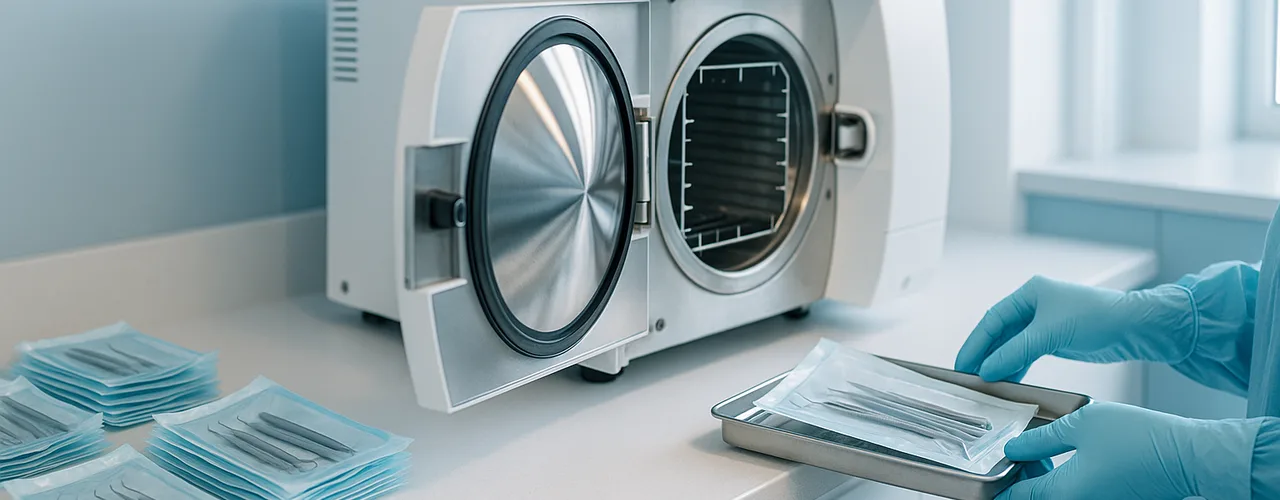
- Sterilisation you can see. Instruments should arrive in sealed pouches opened in front of you, with a colour-changed indicator strip. Ask to see the autoclave. A clinic proud of its protocol will show you; that reaction is itself informative.
- Their own imaging. A clinic doing implants should have or have immediate access to a CBCT scanner. Planning implants from a 2D panoramic alone is a shortcut.
- A written, itemised plan issued after an exam — including materials, brands and total cost.
- Written warranty terms, including what happens when you are 400 miles away.
- Emergency coverage. Who do you call at 9pm on a Sunday, and what does the clinic do if there is a complication after you leave?
Red flags worth walking away from
- A firm price quoted before any imaging or exam.
- Pressure to pay a large deposit today for a "this week only" price.
- Refusal to name the implant brand or the crown material in writing.
- A treatment plan that grows dramatically once you are already in the chair.
- Guarantees of a specific medical outcome. No ethical clinician promises that anywhere in the world.
Practical safety in the city
Separate from clinical quality: Chihuahua City is a large state capital, and the ordinary advice for any large Mexican city applies — stay in central and well-travelled districts, use app-based taxi services or the clinic's arranged transport at night, do not drive long rural stretches after dark, and keep your appointment schedule to daytime hours. Most dental visitors stay in the centre or the Zona Dorada, near the clinics and the hotels, and never need to go further.
For the trip mechanics — permits, routes, flights — see how to get to Chihuahua from the US. To compare the whole market on the same criteria, see the Chihuahua clinic ranking.
Frequently asked questions
Is dental work in Chihuahua safe?
Safety depends on the individual clinic and clinician, not on the city. Verify the specialist's cédula, see sterilisation protocols in person, insist on a written itemised plan, and choose clinics with deep review histories rather than a high average from a handful of reviews.
Are Mexican dentists qualified?
Dentists practising legally in Mexico hold a cédula profesional, and specialists hold a second cédula for their specialty. Both are public numbers you can request and check.
Is the equipment as modern as in the US?
It varies clinic by clinic. Larger Chihuahua clinics commonly have CBCT scanners, digital scanners and in-house labs; smaller practices may not. Ask what imaging they will use to plan your case.
What happens if something goes wrong after I go home?
That is governed by the clinic's written warranty. Ask before treatment what is covered, for how long, and whether return travel is your cost. Get it in writing.
How many Chihuahua clinics are well reviewed?
Of the 209 clinics we track, 169 are rated 4.5 stars or better, but only 32 have 50 or more reviews. Review depth is the more useful filter.
Frequently Asked Questions
Are dentists in Chihuahua safe?
How are Mexican dentists licensed?
What can I verify about a Chihuahua dentist?
What can't anyone promise about dental safety in Chihuahua?
How does the 209-clinic data set help me choose?
Questions this page answers
- are dentists in Chihuahua safe
- is dental work in Mexico safe
- how are Mexican dentists licensed
- dental clinics in Chihuahua Mexico reviews
- what to look for in a Mexican dentist
- Chihuahua dental tourism safety
- are Mexican dentists accredited
- dental quality standards in Mexico
- how to verify a dentist in Mexico
- is it safe to get dental work in Chihuahua