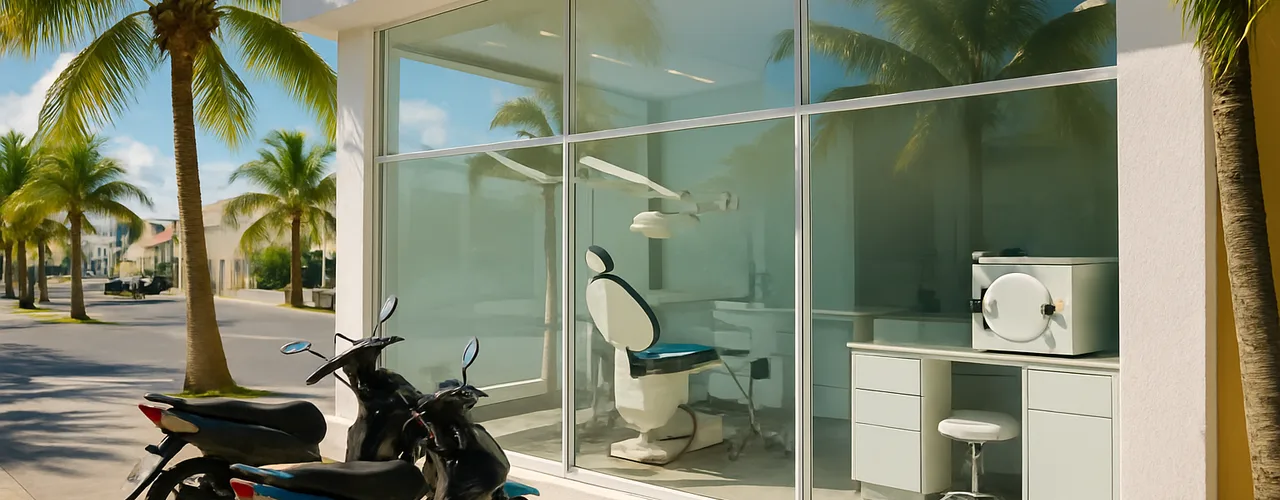
The short answer
Dentistry in Mexico is a licensed profession with university training and a national registry, and Cozumel's 67 tracked clinics include practices that treat international patients every week of the year. The honest risk here is not the country. It is the combination of a tourist market, a time-pressured visitor and a decision made in an afternoon. Everything below is about removing that pressure from the choice.
How dentists are trained and licensed in Mexico
A Mexican dentist completes a university degree in dentistry, then a period of supervised social service before independent practice. Specialists, such as oral surgeons, periodontists, endodontists and prosthodontists, complete additional postgraduate training on top of that. Practising dentists hold a professional licence, the cedula profesional, issued by the education authority, and specialists hold a separate one for the specialty.
You are entitled to ask for those numbers. A clinic that treats foreign patients regularly will not be surprised by the question.
What actually goes wrong, and when
In our experience the problems that generate complaints are rarely exotic. They cluster:
- Decisions made under time pressure. A patient picks a clinic on the day, from a sign near the terminal, because the ship leaves at five.
- No written plan. A verbal price, no itemization, then a different total at the end.
- Treatment scope that does not fit the visit. Work started that cannot be completed before departure.
- No plan for complications. Nobody discussed what happens if something hurts three weeks later, at home.
- Unnamed materials. An implant with no brand stated is a component you may not be able to service later.
None of those are unique to Cozumel or to Mexico. They are what happens anywhere when a medical decision is made like a souvenir purchase.
The verification list
Run this before you commit, and preferably before you travel.
- Licence. Ask for the treating dentist's professional licence number and their specialty licence if a specialist is doing the work.
- Who does what. Ask by name who performs the surgery and who makes the prosthesis. On complex cases those are often different people.
- Written, itemized plan after an exam with imaging. Not a price quoted over chat before anyone has looked in your mouth.
- Named materials. Implant system and prosthetic material, by brand.
- Sterilisation. Ask how instruments are sterilised and whether the autoclave is tested with biological indicators. Ask to see the area. A serious clinic is glad to show it.
- Complication policy. Who is responsible after you leave, what it costs, and whether it requires returning to the island.
- Warranty. In writing, with its duration and its conditions.
- Records. Ask for copies of your images and treatment notes to take home to your own dentist.
The island-specific part
Two things are worth knowing about Cozumel specifically.
First, laboratory work may travel. Some clinics have an in-house lab, others send cases to the mainland. That is not a quality problem, but it affects timing, so ask before you build your schedule around a delivery date.
Second, do not let a departure time drive a clinical decision. If a clinic says the responsible thing is to split the treatment across visits, that is a good sign, not an inconvenience. The clinics that worry us are the ones that agree to anything you propose.
Where a ranking helps, and where it does not
Molar City publishes a free ranking of Cozumel clinics scored from each clinic's public digital footprint: reviews, ratings, website, social presence, photos, profile completeness. It is free, algorithmic and no clinic can pay to move up.
What it measures is visibility and public presence. What it cannot measure is what happens in the operatory, the sterilisation protocol, or how a clinic behaves when something goes wrong. Use the ranking to build a shortlist in ten minutes; use the eight questions above to choose from it.
When to stay home
- You have an active infection or acute pain. Get that treated where you are.
- Your medical history makes surgery abroad risky and your physician has not cleared it.
- You cannot return for a second stage or for warranty work.
- You are being pressured to decide today because of a departure time.
What a good clinic does that a weak one does not
After enough cases you stop looking at marketing and start looking at behaviour. The signals that hold up:
- It says no. To a timeline that does not fit, to a treatment you asked for but do not need.
- It images before it prices. Numbers come after the scan, not before.
- It names people. The surgeon, the prosthodontist, the lab.
- It writes things down. Plan, costs, warranty, follow-up, all on paper.
- It answers the uncomfortable question. What happens if this fails, and who pays.
Those five behaviours cost a clinic nothing and are hard to fake in writing, which makes them a better filter than any review score.
What Molar City is, and is not
Molar City has been an independent dental tourism directory since 2007. We are not a dental clinic, we do not practice dentistry and we do not certify clinical quality. We publish public data and coordinate logistics. The verification above is yours to do, and any licensed dentist worth choosing will help you do it. Start with our Cozumel dental guide.