A traditional dental X-ray is a shadow: it flattens a three-dimensional jaw onto a two-dimensional image. That is fine for spotting most cavities, but it can hide what matters before surgery, such as how close a nerve runs to a tooth root, how wide the bone is, or whether there is a hidden lesion. A cone beam computed tomography (CBCT) scan solves that problem.
This guide from Molar City, an independent dental tourism platform since 2007, explains why biological and holistic dentists consider CBCT essential before many procedures.
How CBCT works
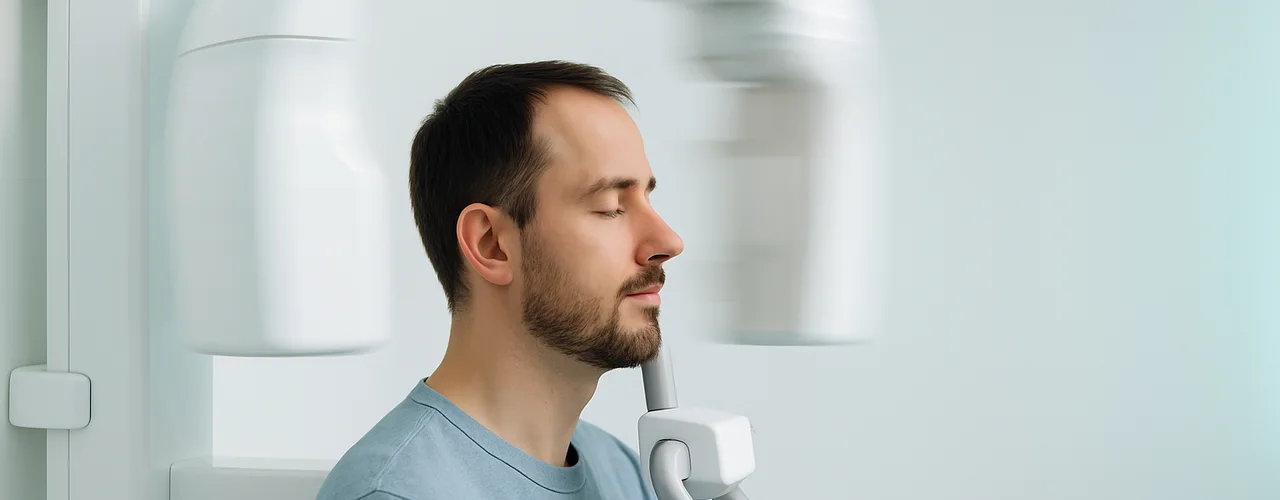
You sit or stand while an arm rotates once around your head, usually in 10 to 40 seconds. A cone-shaped X-ray beam captures hundreds of images that software reconstructs into a 3D volume. The dentist can then slice through the jaw in any direction, measure bone in tenths of a millimeter and trace nerves and sinuses.
Scans can cover a small area (a few teeth), one arch, or both jaws plus sinuses and airway. A smaller field of view means less radiation.
Why biological dentists rely on it
- Implant planning: measuring bone height and width, locating the mandibular nerve and sinus floor, and choosing implant size. This matters even more for zirconia implants, which are one-piece in many systems and cannot be angled as freely.
- Extractions: seeing root shape, nearby nerves and any infection around the roots before a holistic tooth extraction.
- Cavitation evaluation: biological dentists use CBCT to look for areas of altered bone density in old extraction sites, often discussed as NICO or cavitations. Interpretation is debated, and CBCT alone may not confirm a diagnosis; see dental cavitations and NICO.
- Root canal assessment: detecting extra canals, cracks or lesions at the root tip that a 2D image misses. This helps with an honest root canal vs extraction decision.
- Sinus and airway: upper molar infections can involve the sinus; a wider scan shows it.
How much radiation a CBCT involves
Doses vary widely by machine and settings. These approximate ranges, in microsieverts (µSv), come from published dental radiology literature:
| Exam | Approximate effective dose |
|---|---|
| Bitewing X-rays (4 images) | About 5 µSv |
| Panoramic X-ray | About 10 - 25 µSv |
| CBCT, small field (few teeth) | About 20 - 100 µSv |
| CBCT, one or both jaws | About 50 - 200+ µSv |
| Medical CT of the head / jaws | Several hundred to 2,000 µSv |
| Natural background radiation (US, per year) | About 3,000 µSv |
The principle dentists follow is ALARA ("as low as reasonably achievable"): use CBCT when the answer will change the treatment, choose the smallest field of view that answers the question, and avoid repeat scans by sharing files between providers.
When CBCT is not needed
Routine checkups and most cavity detection do not require 3D imaging. Professional guidelines discourage using CBCT as a screening tool for everyone. A thoughtful dentist will explain why a scan is needed for your case. Pregnant patients should discuss timing and necessity with their dentist and physician.
What to ask for
- The DICOM files: the raw 3D data, so your home dentist or surgeon can review it without repeating the scan.
- A written report, ideally reviewed by someone experienced in reading CBCT.
- Field of view used and why.
CBCT cost in Tijuana vs the USA
In Tijuana, the biological clinic American Biodental Center, founded in 1998, publishes these prices for imaging and related care. US figures are typical ranges.
| Service | Published price, American Biodental Center (USD) | Typical US range (USD) |
|---|---|---|
| CBCT scan (one arch) | $140 | $250 - $600 |
| Exam | $40 | $75 - $200 |
| Zirconia implant (implant only) | $1,850 | $2,500 - $4,500 |
| Cavitation surgery (per site) | $180 | $500 - $2,000+ |
| Extraction with cavitation cleaning | $200 | $300 - $800 |
Many travelers schedule the CBCT on day one, so treatment planning and any surgery can happen in the same trip. For an overview of biological care in the city, see our holistic dentist in Tijuana guide, and for technology-focused practices, dentists in Tijuana with the best technology. You can compare clinics in our Tijuana dentist guide.
Consult your dentist about whether 3D imaging is appropriate for your treatment.
What happens during a CBCT appointment
The scan itself is quick and painless. You remove earrings, glasses, removable dentures and anything metal around the head and neck. A technician positions you with a chin rest and sometimes a bite block to keep your head still; you may wear a thyroid collar if it does not block the area being imaged. The arm rotates once, usually in under 30 seconds, and the images are ready for review within minutes.
The more important step comes afterward: interpretation. A CBCT captures much more anatomy than the dentist may be focusing on, including sinuses, airway and parts of the skull base. Ask whether the full volume will be reviewed, and by whom. In complex surgical cases, some dentists send scans to an oral and maxillofacial radiologist for a formal report, which adds a modest fee but can catch incidental findings.
Frequently asked questions
Is a CBCT scan safe?
A dental CBCT uses a much lower dose than a medical CT, roughly equal to a few days to a few weeks of natural background radiation depending on the field of view. It should be used when it will influence treatment decisions.
Do I need a CBCT before dental implants?
Most implant guidelines recommend 3D imaging before placement to measure bone and locate nerves and sinuses. It reduces surgical risk and helps choose the right implant size.
Can CBCT detect cavitations?
CBCT can show areas of changed bone density in old extraction sites, which some biological dentists interpret as cavitations. However, findings are not always conclusive, and diagnosis remains debated in mainstream dentistry.
How much does a dental CBCT cost in Tijuana?
American Biodental Center publishes $140 for a CBCT of one arch, compared with about $250 to $600 in the United States.
Can I take my CBCT home?
Yes. Ask for the DICOM files on a USB drive or download link, plus the written report, so other dentists can review them without repeating the scan.
Frequently Asked Questions
What is a cone beam CT (CBCT) scan and why do dentists use it?
Is a CBCT scan safe? How does its radiation compare to other dental X-rays?
How much does a cone beam CT scan cost in Tijuana compared to the USA?
Do I always need a CBCT scan before dental implant surgery?
What is cavitation surgery and why is a CBCT scan important for it?
Questions this page answers
- what is a cone beam CT scan for dental implants
- why do biological dentists use 3D X-rays
- is a CBCT scan safe radiation compared to regular X-ray
- how much does a cone beam CT cost in Tijuana
- do I need a 3D X-ray before dental implant surgery
- CBCT scan for cavitation surgery Mexico
- dental cone beam cost USA vs Mexico
- best biological dentist in Tijuana for implants
- 3D dental X-ray near me for dental tourism
- is cone beam CT necessary for tooth extraction