The short answer
A single dental implant in Puerto Escondido runs $850 to $1,500 USD, with a zirconia crown on top at $300 to $550. A full-arch All-on-4 runs $8,000 to $13,000 per arch. Those are the published ranges for the city. Where you land inside them depends on things you can ask about before you travel.
What the price should include
- Imaging — panoramic X-ray or CBCT scan, sometimes quoted separately.
- The implant fixture and its brand, which is the biggest single driver of the range.
- The abutment connecting fixture to crown.
- The crown and its material.
- Surgery and follow-up visits.
- Bone graft or sinus lift if the case needs one. This is the usual reason a quote grows after the exam.
A quote that does not itemise those lines cannot be compared with another clinic's quote. Ask for the itemised version and the comparison becomes simple.
A caution specific to a small town
In a market of 76 clinics, not every practice places implants, and fewer have a surgeon with specialist implant training. That is not a knock on the town: it is simply the difference between a small market and a large one. Ask directly who will perform the surgery, what their specialty training is and how many of these cases they do. If the answer is vague, that is information. Larger inland markets like Oaxaca City have more specialists to choose from if your case is complicated.
Is the trip worth it for one tooth?
Often, honestly, no. If you are flying in from the United States or Canada specifically to replace a single tooth, two sets of flights and lodging will consume most of the saving. The arithmetic changes when:
- You already live here or spend part of the year here. Then there is no travel cost at all, and the saving is pure.
- You are treating several teeth, or a full arch, where the absolute saving is large enough to absorb the travel.
- You were coming anyway. A surf season or a long stay turns the dental work into an errand rather than a trip.
We would rather say this plainly than sell a flight that does not pay for itself.
What happens between the two visits
The gap is the part nobody explains properly. After the fixture goes into the bone, it needs to fuse with it, a process called osseointegration that takes months and cannot be hurried by paying more. During that window you typically wear a temporary, and the tooth you are waiting for does not exist yet.
Three practical consequences follow. First, do not book the second trip until the surgeon confirms healing on imaging; booking it in advance pressures everyone into a date that biology may not respect. Second, ask before you leave who you contact if the temporary loosens at home, because it happens and it is not an emergency if you know the plan. Third, keep the imaging and the itemised invoice with you: if you ever need a dentist at home to look at the site, they will want to see what was placed and where.
For residents this whole section is a non-issue, which is the single biggest advantage of living here rather than flying in.
Reference prices
| Treatment | Range (USD) |
|---|---|
| Single dental implant | $850 – $1,500 |
| All-on-4, per arch | $8,000 – $13,000 |
| Porcelain veneer | $350 – $600 |
| Zirconia crown | $300 – $550 |
| Root canal | $200 – $400 |
Why the implant brand matters more than it sounds
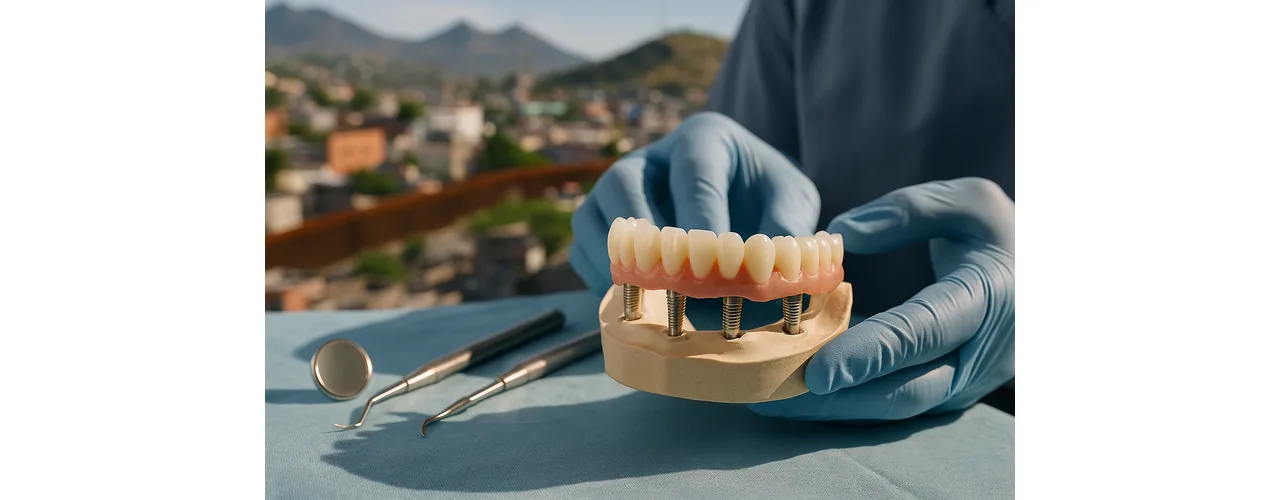
This is the line item patients skip and later regret. An implant fixture is a threaded post that stays in your jaw for decades, and the abutments, screws and tools that fit it are specific to the system it belongs to.
Established international systems are more expensive because they are widely distributed and thoroughly documented. The practical consequence is serviceability: if a screw loosens or a component fractures in five years, a dentist anywhere in the world can identify the system and order the part. With an obscure or unbranded fixture, the dentist at home may be unable to source components at all, and the solution becomes removing an otherwise healthy implant.
So the question is not only "what does it cost today" but "who can service this in ten years, and from where". Ask for the system name and the manufacturer in writing, keep it with your records, and treat a refusal to specify as the answer it is.
How to compare three clinics
Pick three from the Puerto Escondido ranking, ask each for a written plan after imaging, and line them up on six lines: imaging, fixture and brand, abutment, crown and material, graft if needed, follow-up visits. Compare totals only once those six match.
Why is one quote much cheaper than the others?
Usually because something is missing from it: imaging, the abutment, the graft, or a different fixture brand. Ask what is included before you assume it is a bargain.
Will my insurance reimburse me?
Most United States and Canadian plans do not pay foreign providers directly, though some reimburse against an itemised invoice. Check with your insurer first and ask the clinic for the invoice format they require.
How long does an implant take?
Four to eight months from placement to final crown, normally across two visits. If you live here, that is two appointments rather than two trips, which is the main advantage of being a resident.
What Molar City is, and is not
Molar City has been an independent dental tourism directory since 2007. We are not a dental clinic and we do not practice dentistry. The figures here are published ranges for the city, not offers, and no number here replaces a written quote from the dentist who examines you.