Many people grind or clench their teeth during sleep without knowing it. The first clue is often a partner hearing the noise, a sore jaw in the morning, headaches at the temples, or a dentist pointing out flattened, chipped teeth. This habit, called bruxism, can also crack fillings and crowns, and it is one of the most common reasons expensive dental work fails.
This guide from Molar City, an independent dental tourism platform since 2007, explains how night guards and bite splints work and which materials make sense for patients who prefer a metal-free, biocompatible mouth.
Night guard vs bite splint: the difference
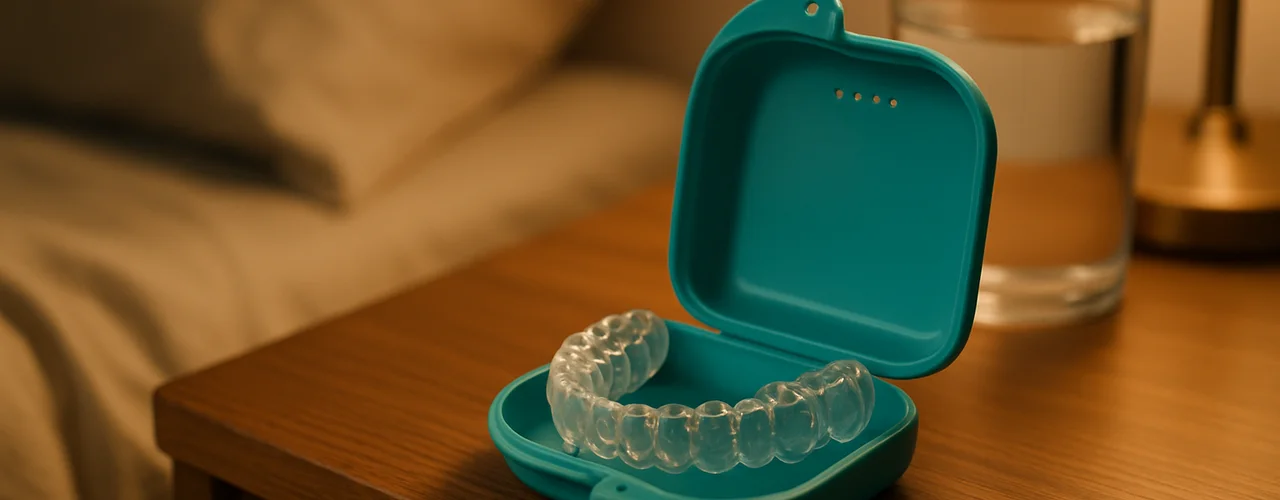
The terms overlap. A night guard usually means a protective cover worn while sleeping. A bite splint or occlusal splint is a custom appliance whose biting surface is carefully adjusted so the jaw muscles can relax and the bite is balanced. A well-made splint does both: it protects teeth and distributes forces evenly.
Types and materials
Virtually all custom night guards are metal-free. The differences are in hardness, comfort and durability:
| Type | Material | Pros | Cons |
|---|---|---|---|
| Soft guard | Flexible thermoplastic (EVA or similar) | Comfortable, inexpensive | Can encourage chewing in some grinders; wears quickly |
| Dual-laminate | Soft inner layer, hard outer layer | Comfortable fit with a durable surface | Thicker; harder to adjust |
| Hard acrylic splint | Heat-processed or milled PMMA | Most durable, precisely adjustable, recommended for heavy bruxism and jaw pain | Requires accurate fabrication and follow-up adjustments |
| Over-the-counter boil-and-bite | Thermoplastic | Cheap, immediate | Poor fit, can alter the bite if worn long term |
Patients concerned about BPA sometimes ask about plastics. PMMA acrylic is not made from BPA, unlike polycarbonate. If you have material sensitivities, ask the clinic which resin they use and whether it is heat-processed or milled, which typically leaves less residual monomer than cold-cured acrylic.
Why splint design matters
- Full coverage: covering all teeth in one arch avoids unwanted tooth movement. Small anterior-only devices can be useful short term but should be supervised.
- Even contacts: the opposite teeth should touch the splint evenly, with smooth guidance when you slide your jaw.
- Follow-up: hard splints usually need one or two adjustment visits as the muscles relax.
A splint protects your teeth and can reduce muscle strain, but it does not cure bruxism. Stress, caffeine, alcohol, some medications and sleep disorders can all contribute.
Bruxism and sleep apnea
Night-time grinding is sometimes linked to disrupted breathing during sleep. If you snore loudly, wake unrefreshed or have daytime sleepiness, ask your physician about sleep apnea screening before relying on a night guard alone. In some cases a different device, a mandibular advancement appliance, prescribed after a sleep study, is more appropriate. Do not treat suspected sleep apnea with a night guard without medical evaluation.
Protecting new dental work
If you are investing in ceramic crowns, onlays or implants, a night guard is inexpensive insurance. Even strong materials can chip under grinding forces. Many dentists recommend a splint after placing same-day ceramic crowns, inlays and onlays or metal-free crowns, and for implants, where there is no natural ligament to cushion forces.
Cost in Tijuana vs the USA
In Tijuana, the biological clinic American Biodental Center, founded in 1998 with an in-house lab, publishes these prices. US figures are typical ranges.
| Service | Published price, American Biodental Center (USD) | Typical US range (USD) |
|---|---|---|
| Custom bite splint | $300 | $400 - $1,000 |
| Exam | $40 | $75 - $200 |
| Cleaning | $35 | $100 - $200 |
| Composite repair of a chipped tooth | $80 | $150 - $350 |
| Porcelain crown (if a tooth has cracked) | $550 | $1,100 - $2,000 |
With an in-house lab, a custom splint can often be delivered within one or two days. For more on biological care, see our holistic dentist in Tijuana guide, and compare clinics in the Tijuana dentist guide.
Caring for your night guard
- Rinse after each use and brush gently with a soft brush and mild soap, not toothpaste, which scratches.
- Store it dry in a ventilated case away from heat and pets.
- Bring it to every dental checkup so the fit and bite can be verified.
- Replace it when it cracks, thins or no longer fits snugly.
Consult your dentist about the right appliance for your bite and symptoms, and your physician if you suspect a sleep disorder.
Signs you may be grinding at night
- Jaw tightness, soreness or clicking when you wake up.
- Dull headaches at the temples, especially in the morning.
- Teeth that look shorter, flat or chipped at the edges.
- Sensitivity to cold caused by worn enamel or small cracks.
- Scalloped edges on the sides of the tongue or ridges on the inner cheeks.
- A partner who hears grinding sounds during the night.
Daytime clenching is also common, especially when concentrating or stressed. A night guard does not address it, but awareness helps: many dentists suggest checking during the day that your lips are together and your teeth apart, with the jaw relaxed. If symptoms persist, a dentist can evaluate the jaw joint and muscles before making a splint.
Frequently asked questions
Are custom night guards metal-free?
Yes. Custom night guards and bite splints are made from acrylic or thermoplastic resins and contain no metal.
Is a hard or soft night guard better for grinding?
For heavy grinding or jaw pain, dentists usually recommend a hard acrylic splint because it is durable and can be precisely adjusted. Soft guards are more comfortable but wear faster and may not suit heavy grinders.
How long does a custom bite splint last?
A hard acrylic splint typically lasts three to ten years depending on how much you grind. Soft guards may need replacing every six to twelve months.
Can a night guard stop bruxism?
No. It protects teeth and can reduce muscle strain, but it does not eliminate the habit. Managing stress, reviewing medications and screening for sleep disorders address underlying causes.
How much does a bite splint cost in Tijuana?
American Biodental Center publishes $300 for a custom bite splint, compared with roughly $400 to $1,000 for a lab-made splint in the United States.
Frequently Asked Questions
What is the difference between a night guard and a bite splint?
Are metal-free night guards available?
Should I be screened for sleep apnea if I grind my teeth?
What types of night guards can I choose from?
Why does splint design matter for the jaw joint?
Can I get a custom night guard in Tijuana?
Questions this page answers
- how much does a custom night guard cost in Tijuana
- best night guard for teeth grinding
- metal-free bite splint for bruxism
- soft vs hard night guard which is better
- night guard for TMJ jaw pain
- can a night guard help sleep apnea
- dentist in Tijuana for night guard
- custom bite splint cost Mexico
- do I need a night guard if I grind my teeth
- affordable night guard for Americans in Mexico