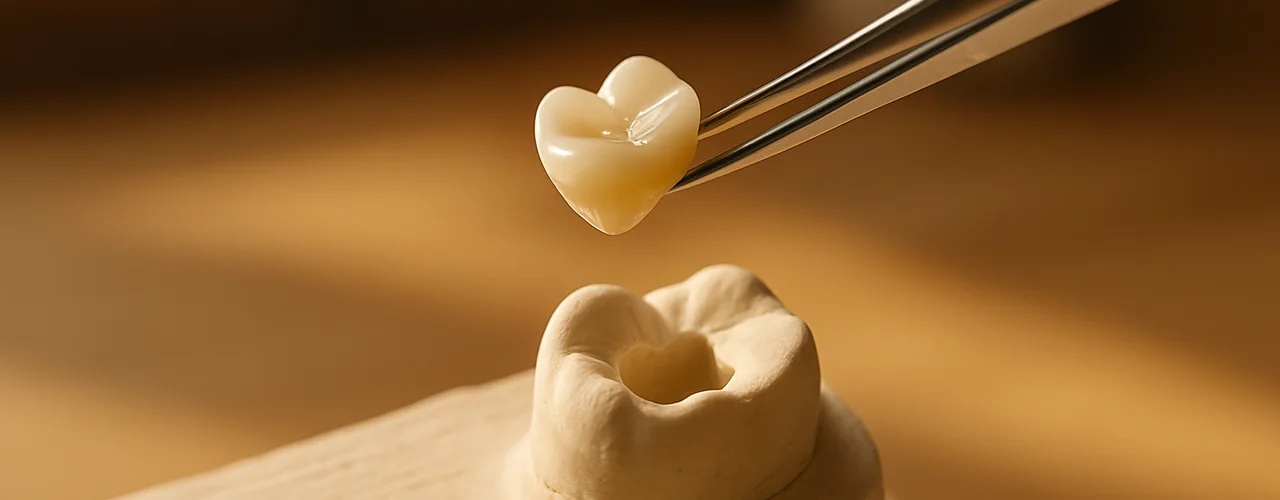
Many adults carry silver amalgam fillings placed 20 or 30 years ago. When one cracks, leaks or simply needs replacing, patients are often told they need a crown. Sometimes that is true. But in many cases there is a more conservative middle ground: a ceramic inlay or onlay, which replaces the old filling and reinforces the tooth while keeping far more of your natural enamel.
This guide from Molar City, an independent dental tourism platform since 2007, compares the options and explains how holistic and biological dentists approach the decision.
Filling, inlay, onlay, crown: the ladder of restorations
Think of restorations as a ladder. Each step up covers more of the tooth and removes more natural structure.
| Restoration | What it covers | Tooth removed | Best for |
|---|---|---|---|
| Direct composite filling | Small to moderate cavity, built up in the mouth | Minimal | Small amalgam replacements |
| Inlay | Inside the cusps (the chewing grooves) | Low | Moderate fillings with strong walls |
| Onlay (partial crown) | One or more cusps | Moderate | Large fillings, weakened or cracked cusps |
| Crown | The entire visible tooth | High (all surfaces reduced) | Severely broken teeth, after many root canals |
A crown preparation typically removes much more healthy tooth structure than an onlay preparation, and once a tooth has been prepared for a crown, you cannot go back. That is why many dentists, holistic or not, favor the least invasive option that will reliably last.
Why old amalgams often lead to bigger restorations
Amalgam does not bond to the tooth. It is held in by mechanical undercuts, so the original cavity was often cut wider than the decay required. Over decades, amalgam expands and contracts with temperature, and cusps around large fillings may develop cracks. When the filling comes out, the dentist sees what is left and decides how much reinforcement the tooth needs.
A bonded ceramic inlay or onlay can act like a splint, holding weakened cusps together. That is the main mechanical argument for choosing an onlay over a new large filling.
How the amalgam is removed
Biological dentists usually remove amalgam with a protective protocol designed to reduce exposure to mercury vapor and particles: rubber dam isolation, high-volume suction, cooling water, sectioning the filling in chunks rather than grinding it, and air filtration. The IAOMT calls its version the SMART protocol. Our guide to safe amalgam removal in Mexico explains each step.
A balanced note: the FDA (2020) recommends that certain higher-risk groups avoid new amalgam fillings when appropriate, but it does not recommend removing amalgams that are in good condition, because removal itself releases mercury vapor. Replacing a filling that is failing is a different situation. Discuss with your dentist whether replacement is actually indicated.
Materials for metal-free inlays and onlays
- Lithium disilicate (e.max-type): strong, natural-looking, bonded. The most common choice for onlays.
- Feldspathic ceramic: highly esthetic and kind to opposing teeth.
- Zirconia: very strong but less often used for thin onlays because it does not bond as well.
- Composite or hybrid ceramic: lab-cured resin blocks, easy to repair, slightly less wear resistant.
Patients concerned about material sensitivity sometimes request biocompatibility testing before choosing; ask your dentist whether it is useful in your case. Bonding cements are resin-based; if you also want to reduce BPA-related exposure, read our guide to BPA-free composite fillings.
One visit or two
Inlays and onlays can be made in an outside lab (two visits with a temporary) or milled chairside with CAD/CAM the same day. Clinics with in-house milling can often remove the amalgam, scan and place the ceramic onlay in a single appointment. See same-day CEREC crowns in Mexico for how that workflow works.
Prices in Tijuana vs the USA
In Tijuana, American Biodental Center, a biological clinic founded in 1998, publishes the following prices on its website. US figures are typical ranges.
| Treatment | Published price, American Biodental Center (USD) | Typical US range (USD) |
|---|---|---|
| Amalgam removal (per tooth) | $100 | $100 - $300 |
| Composite (resin) filling | $80 | $150 - $350 |
| Ceramic inlay | $400 | $650 - $1,200 |
| Ceramic onlay | $450 | $800 - $1,500 |
| Porcelain crown | $550 | $1,100 - $2,000 |
Note that removal and the new restoration are usually billed separately. A patient replacing four large amalgams with onlays might budget roughly $2,200 in Tijuana at these published prices, versus $3,600 to $7,200 in the US. For crown prices across the city, see our Tijuana crowns guide, and for an overview of holistic practices, the holistic dentist in Tijuana guide.
How dentists decide: a quick checklist
- Remaining wall thickness: thin cusps (under about 2 mm) usually need to be covered by an onlay.
- Cracks: visible crack lines under the old filling favor cusp coverage.
- Root canal treated? Back teeth after a root canal generally need cusp coverage (onlay or crown).
- Bite forces: heavy grinders may need stronger materials and a night guard.
The final call can only be made once the old filling is out and the dentist sees the tooth. Consult your dentist before deciding on a treatment plan.
Frequently asked questions
Is an onlay better than a crown?
Not always better, but more conservative. If the tooth has enough healthy structure, a bonded onlay preserves enamel and gum-level tooth, and studies show long-term survival comparable to crowns. A severely broken tooth still needs a crown.
How long do ceramic inlays and onlays last?
Well-made bonded ceramic inlays and onlays commonly last 10 to 20 years. Survival depends on hygiene, grinding habits and the quality of the bonding.
Should I replace all my amalgam fillings at once?
Not necessarily. Many dentists replace only fillings that are cracked, leaking or decayed. Removing intact amalgams releases some mercury vapor, so the decision should be individual and discussed with your dentist.
Can an inlay be done in one visit?
Yes, at clinics with CAD/CAM milling. The old filling is removed, the tooth is scanned, and the ceramic inlay is milled and bonded the same day.
How much does an onlay cost in Tijuana?
American Biodental Center publishes $450 for a ceramic onlay and $400 for an inlay, compared with roughly $800 to $1,500 for an onlay in the United States.
Frequently Asked Questions
What is the difference between an inlay, an onlay, and a crown?
When can an inlay or onlay be used instead of a crown?
How does amalgam removal fit into this?
Are inlays and onlays available at dental clinics in Mexico?
Are ceramic inlays and onlays as strong as crowns?
Questions this page answers
- inlay vs onlay vs crown what's the difference
- how much does a ceramic inlay cost in Mexico
- replacing old amalgam fillings with inlays or onlays
- is an onlay better than a crown
- amalgam removal dentist in Tijuana
- dental crown cost in Tijuana vs USA
- conservative tooth restoration options
- best dentist in Tijuana for fillings and crowns
- can I get an inlay instead of a crown
- dental work in Mexico safe for Americans