"Holistic" and "biological" are not protected titles. Any dentist can use them on a website, which makes choosing one harder than it looks. Some practices invest heavily in training and safety equipment; others mainly use the words for marketing. This guide from Molar City, an independent dental tourism platform since 2007, gives you a practical way to tell the difference.
What biological dentistry means in practice
Biological dentists generally emphasize minimally invasive care, metal-free and biocompatible materials, protective protocols for removing amalgam fillings, and attention to how oral health relates to overall health. Most also hold the same dental degree as any general dentist. For a full introduction, start with our holistic dentist in Tijuana guide.
IAOMT: what the levels mean
The International Academy of Oral Medicine and Toxicology (IAOMT), founded in 1984, is the best-known professional group in this field. It publishes position papers and runs a training pathway. Common designations you may see:
| Designation | What it generally indicates |
|---|---|
| Member | Belongs to the academy; no specific exam required |
| SMART Certified | Completed training and testing on the Safe Mercury Amalgam Removal Technique |
| Accredited (AIAOMT) | Completed a structured curriculum and examination in biological dentistry |
| Master (MIAOMT) / Fellow (FIAOMT) | Advanced hours of education, scientific review work and contribution to the academy |
The IAOMT keeps a public directory where you can check a dentist's status. Membership alone does not guarantee quality, but SMART certification at least tells you the dentist was trained on safe removal.
IABDM
The International Academy of Biological Dentistry and Medicine (IABDM), founded in 1985, brings together dentists, physicians and other practitioners interested in integrative approaches. It offers education and a member directory. Its focus is broader and more integrative than the IAOMT's.
Verify the basics first
Holistic credentials are an addition to, not a replacement for, standard licensing. In Mexico:
- Every dentist must hold a cédula profesional, searchable in the federal professional registry (Registro Nacional de Profesionistas).
- Specialists, such as oral surgeons or endodontists, should have a specialty cédula and ideally certification from their specialty council.
- Clinics operate under health authority (COFEPRIS / state) notices and permits.
Our guides on licensing of Tijuana dentists and how to choose the best dentist in Tijuana explain the process step by step.
Equipment and protocols to look for
- Rubber dam and high-volume suction for every amalgam removal.
- Air filtration near the patient's mouth and in the operatory.
- Amalgam separator on the plumbing, to keep mercury out of wastewater.
- CBCT 3D imaging before implants, extractions or cavitation surgery; see why biological dentists use CBCT.
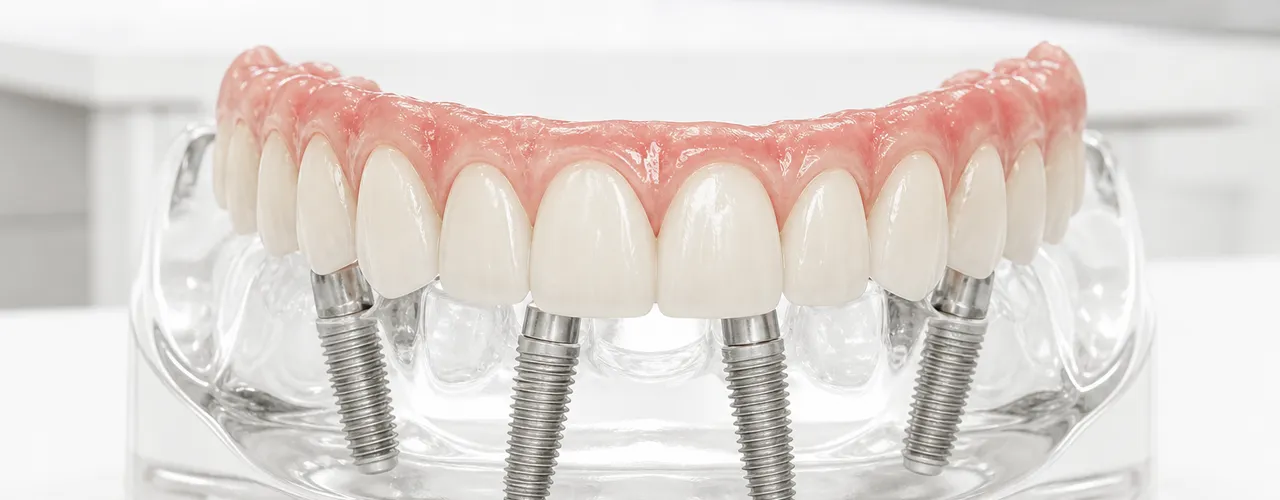
- Metal-free materials such as ceramic crowns, composite fillings and zirconia implant options.
- Clear sterilization procedures you can ask to see.
Questions to ask before you book
- What is your dental training, and which holistic certifications do you hold?
- Exactly how do you remove amalgam fillings? Do you follow the IAOMT SMART protocol?
- Will you show me my X-rays or CBCT and explain the findings?
- For each recommendation, what are the alternatives, including doing nothing?
- Do you ever recommend keeping a root canal tooth? (A balanced practice should say yes when appropriate.) See root canal vs extraction.
- What is the total written cost, including tests, sedation and follow-up?
- What warranty do you offer, and how do you handle complications after I return home?
Red flags
- Promises that dental work will cure a chronic disease.
- Pressure to extract many teeth or remove all fillings immediately, without imaging or a second opinion.
- Refusal to share X-rays, scan files or a written treatment plan.
- Only cash payment and no written receipt or warranty.
- Dismissing your physician's input.
A good biological dentist explains risks and benefits honestly and respects that you may choose a conservative path.
An example in Tijuana
American Biodental Center was founded in 1998 by Alessandro Porcella and worked with Dr. Hal Huggins from 1999 to 2014 (see what is the Huggins Protocol). The clinic references IAOMT and IABDM on its website, uses CBCT and Dentsply Sirona CAD/CAM, and runs its own lab. It publishes prices such as a $40 exam, $35 cleaning, $140 CBCT per arch and $100 per tooth for amalgam removal. Use the same checklist above with any clinic, this one included, and compare options in our Tijuana dentist guide.
Consult your dentist and physician before starting any treatment plan.
Evaluating a clinic from home
Most dental travelers choose a clinic before ever meeting the dentist, so the remote consultation matters. Send recent X-rays or ask whether the clinic recommends a CBCT on arrival. Pay attention to how your questions are answered: a good clinic replies in writing, explains the reasoning behind each recommendation and gives an itemized quote rather than a single round number.
Read reviews on more than one platform and look for detailed ones that describe the treatment, the communication and how problems were handled, not just star ratings. A short video call with the dentist, not only a coordinator, is a reasonable request. Finally, ask what happens if you need help after returning home: whether the clinic has a referral network, how warranty claims work and who pays for travel if a repair is needed.
Frequently asked questions
What is the difference between a holistic and a biological dentist?
The terms are often used interchangeably. "Biological" usually stresses biocompatible materials and safe removal protocols, while "holistic" emphasizes the connection between oral and overall health. Neither is a regulated specialty.
Is an IAOMT member automatically a good dentist?
No. Membership shows interest in the field, while SMART certification and accreditation show completed training. You should still verify licensing, reviews, communication and clinical results.
How do I verify a Mexican dentist's license?
Ask for the dentist's cédula profesional number and search it in Mexico's federal professional registry. Specialists should also have a specialty cédula.
Should a biological dentist ever recommend a root canal?
A balanced dentist will discuss root canal treatment as a valid, evidence-based option for many teeth, alongside extraction and implant. Be cautious with any practice that rules it out for everyone.
How much does a first visit cost at a biological clinic in Tijuana?
American Biodental Center publishes $40 for an exam, $35 for a cleaning and $140 for a CBCT scan of one arch, far below typical US fees.
Frequently Asked Questions
What is the difference between a biological dentist and a holistic dentist?
What does IAOMT stand for and why does it matter?
How can I verify a dentist's license in Mexico?
What safety equipment should a biological dentist have?
What are red flags when choosing a biological dentist in Mexico?
Is it safe to get dental work from a biological dentist in Tijuana?
Questions this page answers
- how to choose a biological dentist in Mexico
- what is IAOMT accreditation
- what does IABDM stand for
- how to verify a dentist's license in Mexico
- questions to ask a holistic dentist before booking
- red flags when choosing a dentist in Tijuana
- is it safe to see a biological dentist in Mexico
- what safety equipment should a biological dentist have
- how to find a trustworthy dentist in Mexico for Americans
- IAOMT vs IABDM which is better
- biological dentist vs holistic dentist difference
- dental tourism Tijuana safety checklist