For more than 40 years, titanium has been the default material for dental implants. Zirconia — a white, tooth-colored ceramic — arrived later and is now the implant of choice in most biological dental practices. Both work. The right one depends on your mouth, your health history and your priorities.
This comparison is part of our guide to holistic dentistry. If you are mainly interested in prices, see zirconia implant costs in Tijuana.
The two materials in plain terms
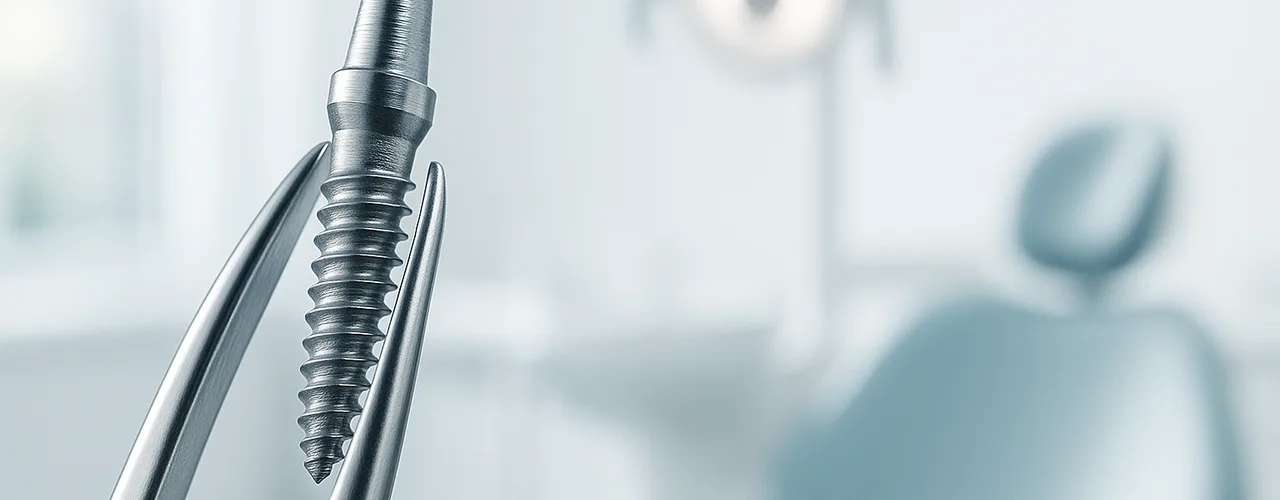
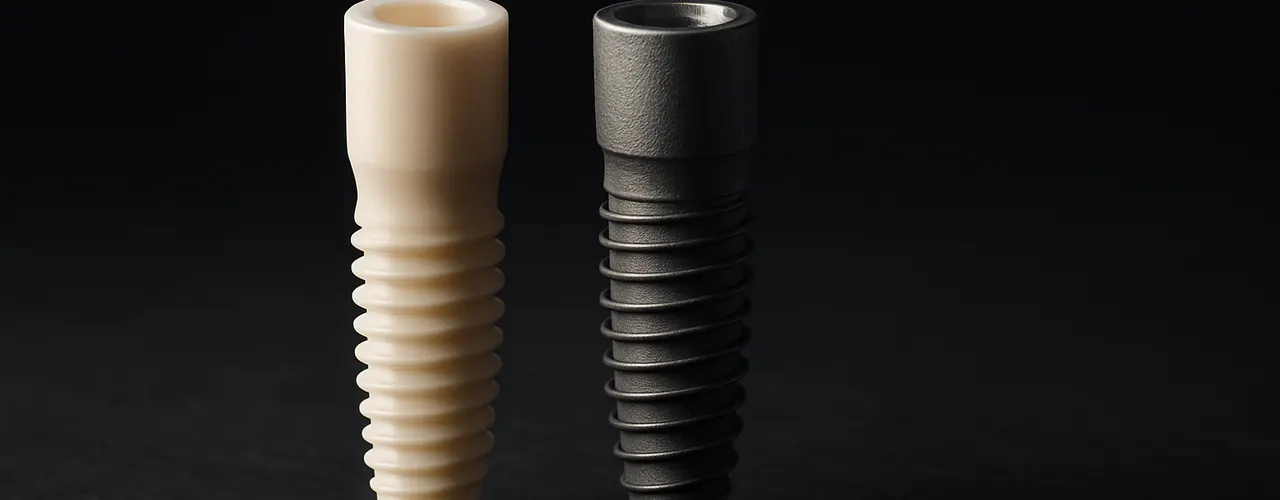
Titanium implants are made of commercially pure titanium or a titanium alloy (usually with small amounts of aluminum and vanadium). They are typically two-piece: a screw in the bone and a separate abutment on top, which gives the dentist flexibility in angling the crown.
Zirconia implants are made of yttria-stabilized zirconium dioxide, a high-strength ceramic. Despite the name "zirconium", the finished implant is a ceramic oxide, not a metal in the everyday sense. They were originally one-piece designs (implant and abutment fused); two-piece zirconia systems are now available as well.
Side-by-side comparison
| Factor | Zirconia (ceramic) | Titanium |
|---|---|---|
| Track record | Roughly 15–20 years of modern data | 40+ years of data |
| Reported short/medium-term survival | Around 95% in recent reviews (fewer long-term studies) | Around 95–98% at 10 years |
| Color | White; no grey show-through | Grey; can show through thin gums |
| Metal content | None | Titanium alloy |
| Plaque and gum response | Studies suggest lower plaque adhesion | Good, well documented |
| Design flexibility | More limited, especially one-piece | Very flexible, many components |
| Fracture risk | Low, but higher with narrow diameters | Very low |
| Typical US price (complete) | $4,500 – $7,000 | $3,500 – $6,000 |
Survival figures come from published systematic reviews and vary by study; your own outcome depends far more on bone quality, surgical skill, smoking and oral hygiene than on the material.
Advantages of zirconia implants
- Aesthetics: no dark collar or grey shadow at the gumline, which matters most for front teeth and thin gum tissue.
- Metal-free: the obvious choice for patients with a confirmed titanium or metal sensitivity, or a strong personal preference.
- Soft tissue: several studies report favorable gum attachment and lower bacterial adhesion around zirconia.
- No galvanic interaction: no metal-to-metal contact with other restorations in the mouth.
Disadvantages of zirconia implants
- Less long-term data than titanium, especially beyond 10 years.
- Less flexibility: one-piece designs must be placed at the correct angle from day one and should be protected from loading while they heal.
- Brittleness: ceramics resist compression well but are less forgiving of bending; very narrow implants or heavy grinders may be at higher risk.
- Fewer specialists place them regularly, so experience matters.
- Higher price in most markets.
How common is titanium allergy?
True titanium allergy appears to be uncommon — studies estimate well under 1% of implant patients — although it is difficult to test for. Some patients report sensitivity without a clear test result. If you have a history of reactions to metal jewelry, orthopedic hardware or previous implants, mention it; some biological clinics offer material biocompatibility testing or MELISA-type tests, which have their own limitations.
Who should consider ceramic?
- Patients replacing a front tooth with thin gums or a high smile line.
- Patients with a documented metal sensitivity.
- Patients committed to a fully metal-free mouth, often after amalgam removal.
- Non-smokers with good bone volume and a stable bite (or willing to wear a night guard).
Titanium is often the more practical choice for complex full-arch reconstructions, severe bone loss, heavy bruxism, or when many angled components are needed. Some patients combine both: zirconia in the front, titanium for full-arch support. Your dentist should explain why one fits your case better.
Where to get zirconia implants in Mexico
Ceramic implants are widely available in Tijuana. American Biodental Center, for example, focuses on zirconia implants, plans them with in-house CBCT imaging and fabricates crowns in its own CAD/CAM laboratory. The clinic publishes a price of $1,850 for the zirconia implant and $2,500 including abutment and crown. Compare options in our Tijuana dentist guide and ask any clinic how many zirconia implants its surgeons place each year.
How surgery and healing differ
For the patient, placing a zirconia or a titanium implant feels much the same: local anesthesia (sometimes with IV sedation), a small opening in the gum, a precisely drilled site and the implant threaded into the bone. The differences are in the details.
- Planning matters more with one-piece zirconia. Because the abutment is part of the implant, the angle cannot be corrected later. That is why clinics rely on a 3D CBCT scan and often a surgical guide.
- Protection during healing. A one-piece zirconia implant sticks out through the gum from day one, so it is protected from chewing with a splint, a bonded temporary or a soft diet. Titanium implants are often "buried" under the gum while they heal.
- Healing time. Most dentists wait about 4–6 months before loading a zirconia implant with its final crown; titanium is often loaded after 3–4 months, sometimes sooner.
- Adjuncts. Biological clinics commonly add PRF and ozone during placement. These can be used with either material.
Whatever the material, the factors you control matter most: not smoking, keeping the area clean, attending follow-ups and wearing a night guard if you grind your teeth.
Frequently asked questions
Are zirconia implants as strong as titanium?
Modern zirconia has high compressive strength and performs well in published studies, but titanium is more tolerant of bending forces and has longer data. For most single teeth, both are strong enough when placed correctly.
Do zirconia implants last as long as titanium?
Short- and medium-term survival rates are similar in recent reviews, around 95%. Titanium has decades more follow-up data, so long-term comparisons beyond 10 years are still limited.
Can a titanium implant be replaced with zirconia?
Yes, but removing an integrated implant is surgery and usually requires bone grafting and healing before a new implant is placed. It should be done for a clear clinical reason, not routinely.
Is zirconia the same as zirconium metal?
No. Zirconia is zirconium dioxide, a ceramic. It contains no free metal and behaves very differently from metallic zirconium.
Are zirconia implants worth the extra cost?
They are worth it when aesthetics in the front of the mouth or a documented metal sensitivity are priorities. For back teeth in a patient without sensitivity, titanium is a well-proven and often cheaper option.
Frequently Asked Questions
Are zirconia implants as strong as titanium implants?
What is the success rate of zirconia implants compared to titanium?
Who is a good candidate for ceramic (zirconia) implants?
Do zirconia implants look better than titanium implants?
Can I get zirconia implants in Mexico?
Are ceramic implants safe for people with metal allergies?
Questions this page answers
- zirconia vs titanium dental implants which is better
- are ceramic dental implants as strong as titanium
- zirconia dental implants pros and cons
- titanium dental implant pros and cons
- metal free dental implants for metal sensitivity
- are zirconia implants safe
- zirconia implant success rate vs titanium
- who should choose ceramic dental implants
- dental implants in Mexico cost
- best dental implants for people with metal allergies
- ceramic vs titanium implant aesthetics
- are ceramic implants worth it