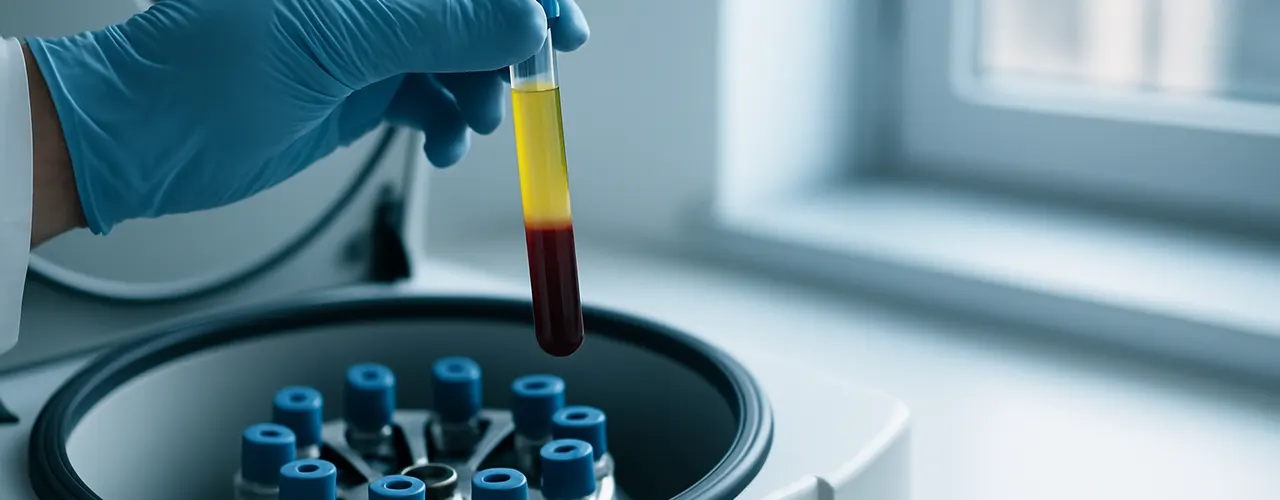
Platelet concentrates are one of the few "biological dentistry" tools that have crossed fully into mainstream oral surgery. The idea is simple: take a small sample of your own blood, spin it in a centrifuge, and place the platelet-rich part where you need healing. No synthetic material, no donor tissue.
This guide explains PRF and PRP, what the evidence shows, and what to expect. It is part of our holistic dentistry guide.
PRP vs PRF: what is the difference?
Both come from your blood. The difference is in how they are made and how they behave.
| Feature | PRP (platelet-rich plasma) | PRF (platelet-rich fibrin) |
|---|---|---|
| Generation | First generation (1990s) | Second generation (2000s) |
| Anticoagulant | Yes | No |
| Form | Liquid or gel | Solid fibrin clot, membrane or plug; also liquid "i-PRF" |
| Growth factor release | Fast, over hours | Slower, over 1–2 weeks |
| Preparation | Two spins, additives | Single spin, nothing added |
| Typical dental use | Mixed with grafts | Extraction sockets, membranes, sinus lifts, implants |
In modern dentistry, PRF (including variants such as L-PRF, A-PRF and i-PRF) is more commonly used because it is simpler to prepare, needs no additives and forms a scaffold that holds in place. Clinics often say "PRP" loosely to mean either.
How the procedure works
- Blood draw: a nurse or dentist draws one to four small tubes from your arm, similar to a routine blood test.
- Centrifuge: the tubes spin for about 8–14 minutes. The blood separates into red cells at the bottom and a yellow, platelet-rich fibrin layer above.
- Preparation: the fibrin clot is shaped into plugs or pressed into thin membranes; liquid i-PRF can be mixed with bone graft material.
- Placement: the PRF goes into the extraction socket, around an implant, over a graft or under the gum, before closing.
The whole process adds roughly 15–20 minutes to the appointment.
What does the research say?
Platelet concentrates have been studied extensively, and results are encouraging but not uniform.
- Wisdom tooth extraction: several systematic reviews report reduced pain and a lower rate of dry socket (alveolar osteitis) when PRF is placed in the socket.
- Soft tissue healing: faster gum closure and less swelling are commonly reported.
- Socket preservation: PRF may help limit bone loss after extraction, though grafting materials remain the standard when maximum preservation is needed.
- Implants and sinus lifts: PRF is used to cover grafts and membranes; evidence for improved implant survival is limited.
- Gum recession: PRF membranes have been compared with connective tissue grafts, with mixed but sometimes favorable results.
Because the material comes from your own blood, the risk of allergic reaction or disease transmission is essentially nil. The main risks are those of the blood draw itself (bruising) and of the surgery it accompanies.
Who benefits most?
- Patients having holistic or wisdom tooth extractions.
- Patients receiving implants, including zirconia implants in Tijuana.
- Patients undergoing cavitation surgery or bone grafting.
- Smokers or people with slower healing — though PRF cannot fully offset the effects of smoking.
It may be less effective in people with very low platelet counts or those on certain anticoagulants. Tell your dentist about all medications.
PRF and ozone together
Many biological clinics combine PRF with ozone irrigation of the surgical site. Ozone is used for disinfection, PRF for healing. The combination is common in biological practice; evidence for the combined benefit is still limited. Read about ozone therapy in dentistry.
Cost in Mexico vs the US
American Biodental Center in Tijuana publishes a combined PRP/ozone price. US figures are typical ranges and vary by office.
| Item | Tijuana (published by the clinic) | Typical US range |
|---|---|---|
| PRP / ozone (per application) | $100 | $150 – $500 |
| Extraction with cavitation cleaning | $200 | $300 – $900 |
| Zirconia implant + abutment + crown | $2,500 | $4,500 – $7,000 |
American Biodental Center includes PRF and ozone among its standard surgical options. Compare other clinics in our Tijuana dentist guide, and always ask whether PRF is included in a surgical quote or charged per site.
PRF vs bone grafts and membranes
PRF is sometimes presented as a replacement for bone grafts. In most cases it is better thought of as a partner. Bone graft materials (from human, animal or synthetic sources) provide a physical scaffold that holds space while new bone forms; collagen membranes keep gum tissue out of the graft. PRF adds a concentrated dose of your own growth factors and a natural fibrin network.
- For a simple extraction with no implant planned, PRF alone is often enough.
- For socket preservation before an implant, many surgeons mix liquid PRF with graft particles ("sticky bone") and cover it with a PRF membrane.
- For large defects or sinus lifts, a graft remains necessary; PRF supports it.
Patients who prefer to avoid animal-derived materials can ask about synthetic grafts combined with PRF.
How to prepare
Drink plenty of water the day before and the day of surgery, which makes the blood draw easier. Eat normally unless you are having sedation, in which case follow the fasting instructions. Tell the clinic about any anticoagulants or supplements that affect bleeding, such as high-dose fish oil or ginkgo.
Frequently asked questions
Is PRF the same as PRP?
No. Both are made from your blood, but PRF uses no anticoagulant, forms a solid fibrin scaffold and releases growth factors more slowly. PRP is liquid and needs additives. Many clinics use the terms interchangeably, so ask which one they mean.
Does PRF really speed up healing?
Studies show benefits for pain, swelling and dry socket after extractions, and for soft tissue healing. The effect varies between patients and procedures, so think of it as a helpful adjunct rather than a guarantee.
Does the blood draw hurt?
It feels like a routine blood test: a brief pinch. Only a small amount of blood is needed, usually 10 to 40 milliliters.
How much does PRF cost in Tijuana?
American Biodental Center publishes $100 per PRP/ozone application. In the US, PRF is commonly billed at $150 to $500 per site.
Is PRF safe?
Because it is made from your own blood with no additives, PRF has a very good safety profile. The main risks are bruising at the draw site and the usual risks of the surgery itself.
Frequently Asked Questions
What is the difference between PRF and PRP in dentistry?
Does PRF really help you heal faster after a tooth extraction?
What does PRF treatment feel like?
How much does PRF or PRP cost in Mexico compared with the US?
Is PRF safe?
Can I get PRF with dental implants in Mexico?
Questions this page answers
- what is PRF in dentistry
- PRF vs PRP dental difference
- does PRF help you heal faster after a tooth extraction
- is PRF worth it for dental implants
- how much does PRF cost in Mexico
- PRF dental treatment cost US vs Mexico
- is PRF safe at the dentist
- what does PRF treatment feel like
- best dentist in Mexico for implants with PRF
- affordable dental implants in Los Algodones
- do Mexican dentists use platelet rich fibrin
- is dental work in Mexico safe