The short answer
Querétaro fits patients who need several appointments and want a full-size city behind the treatment. Molar City tracks 161 dental clinics in Querétaro, which makes it the largest dental market we measure in central Mexico outside the capital. Treatment runs roughly 50 to 65 percent below United States private-pay prices, Querétaro International Airport (QRO) has direct flights from Houston, Dallas and Chicago, and the climate is dry and temperate year round, so there is no rainy season or hurricane season to plan around.
Molar City is an independent dental tourism directory, publishing since 2007. We are not a dental clinic and we do not practice dentistry. What we do is coordinate the travel and the communication between patient and clinic, and publish a free, algorithmic ranking of clinics based on their public digital footprint. No clinic can pay to move up in it.
Why Querétaro is on our list at all
Because the clinic count came back much larger than we expected. Querétaro was the single biggest surprise of our 2026 expansion scan. The city returned 161 tracked clinics, more than the counts we had on record at the time for Cancún and Monterrey, which sat at 92 each before we re-scanned those two markets and revised them upward to 193 and 244.
The leaderboard is not the point. The point is that a city most American and Canadian patients have never considered has a dental sector deep enough to give you actual choice, including specialists rather than only general dentists. The reason is economic rather than medical. Querétaro is one of Mexico's industrial and aerospace hubs with a large private hospital sector, serving a local professional population that pays out of pocket for private care. The dental clinics grew to serve that population. Foreign patients are a side effect of a market that already existed, which is a different situation from a border town where the dental sector exists mainly because of foreign patients.
What the city is like
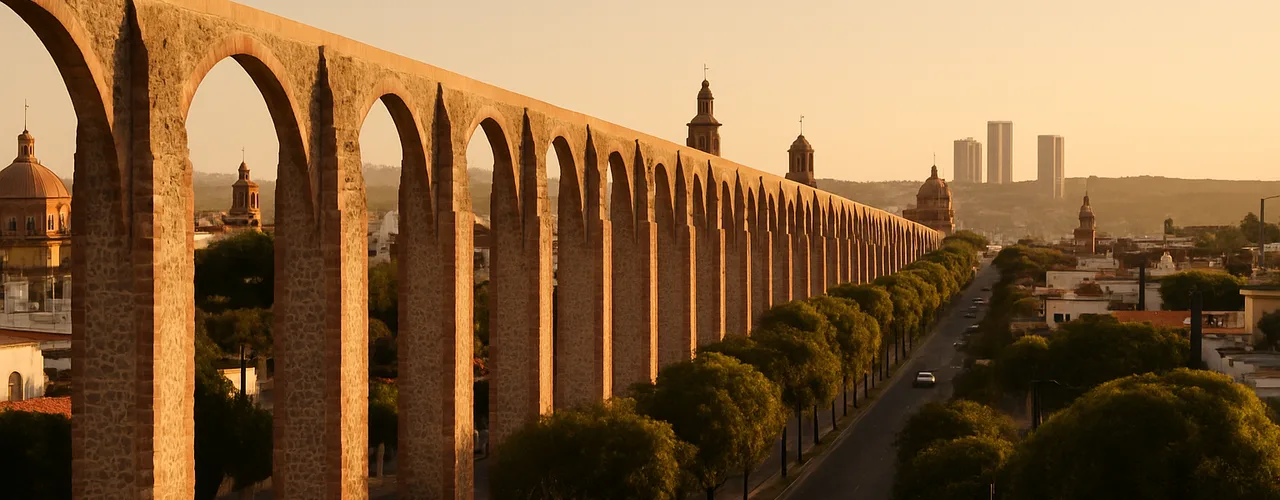
A modern industrial city wrapped around a colonial center that carries UNESCO World Heritage status. Practically, that means you get paved arterials, chain hotels, ride-hailing, reliable internet and private hospitals, plus a walkable historic downtown with plazas, restaurants and hotels inside converted colonial buildings. It reads as a working city rather than a resort, and it has a reputation as one of the safer cities in Mexico.
That matters more than it sounds when your treatment plan spans a week or two. Long plans mean waiting days between appointments. A city with something to do and a downtown you can walk in the evening is easier to sit through than a strip of clinics next to a border crossing.
What people actually travel here for
Implants and full-arch work
This is the main reason to fly. A single implant runs $900 to $1,600 USD, and a full-arch All-on-4 runs $8,500 to $14,000 per arch. When the treatment total is in the thousands, a 50 to 65 percent difference is large enough to absorb flights and a hotel and still come out well ahead.
Crowns, bridges and veneers
Zirconia crowns run $350 to $600. Multi-unit cases, full smile rehabilitation and combined crown-and-implant plans are common here because the arithmetic works once you are past a handful of units.
Root canals, extractions and periodontal work
Usually done as part of a larger plan rather than as the reason for the trip, often bundled ahead of implants.
What is usually not worth flying for
One filling, one cleaning, one crown. The savings on a single small item rarely cover a plane ticket and two nights of hotel. If that is your situation, read our comparison of Querétaro against a border town you can drive to.
Reference prices
| Treatment | Querétaro range (USD) |
|---|---|
| Single dental implant | $900 - $1,600 |
| Zirconia crown | $350 - $600 |
| All-on-4, full arch | $8,500 - $14,000 |
These are ranges across the market, not a quote. Where a case lands inside the range depends on the implant system, the prosthetic materials, whether grafting is needed and whether a specialist or a general dentist performs the work. Any clinic that gives you a firm number before seeing imaging is guessing.
How long you need to be there
Crown and bridge work usually fits into one trip of several days, with impressions or a scan early and delivery a few days later. Implant work is normally two trips: placement first, a healing period decided by your dentist, then a return visit for the final restoration. Some full-arch plans deliver a temporary prosthesis in the first trip. Ask the clinic to put the number of trips and the number of days in writing before you book anything, because a plan that turns out to need three trips instead of two changes the total cost more than the price per implant does.
Getting there
QRO has direct service from Houston, Dallas and Chicago, and the airport sits about 30 minutes from the city center. If your home airport does not connect well, the alternative is flying into Mexico City and covering the remaining distance by road in roughly three hours, which many patients prefer because fares into a major hub are often cheaper and more frequent.
Choosing a clinic
Start with the free Molar City ranking for Querétaro. It scores clinics on their public digital footprint and nobody can buy a position. Be clear about what that measures: how visible, documented and consistent a clinic is in public, not the outcome of your treatment. Use it as a filter, then do your own verification.
- Ask who performs the surgery and whether that person is a specialist or a general dentist.
- Ask for an itemized written quote, line by line, not a single package number.
- Ask for the implant system and prosthetic materials by brand name.
- Ask what the written warranty covers and what happens if something fails after you fly home.
- Ask whether imaging is done on site and whether the plan can change after they see it.
- Ask who you contact from home, in what language, on which day of the week.
When Querétaro is the wrong answer
Skip it if your case is one small item, if you cannot return for a second trip, if you are in pain right now and need care today, or if you have a medical condition that your own physician has not cleared for travel and surgery. Distance is a real cost. It is worth paying when the treatment is large or complex, and not worth paying when it is neither.