The short answer
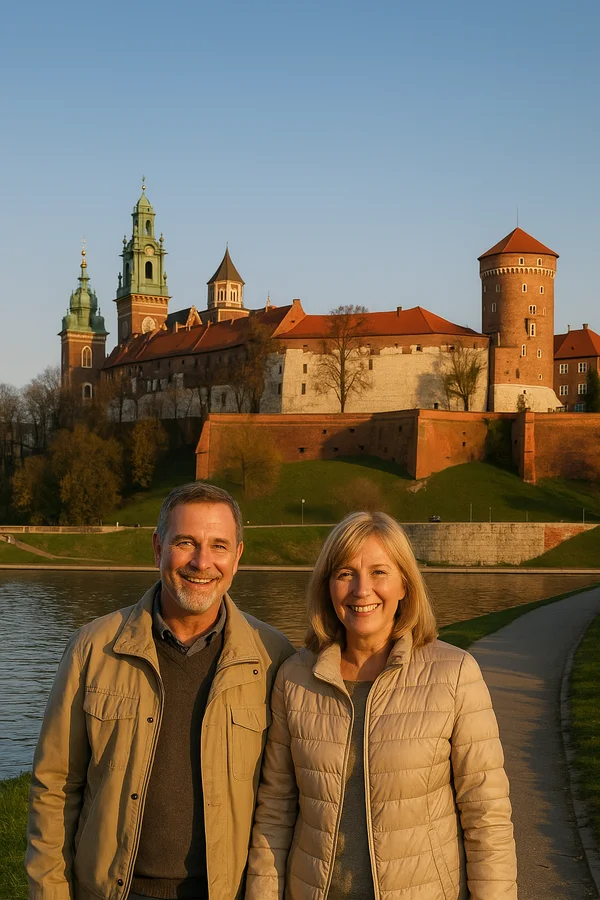
Kraków is Poland's second-largest city and its former royal capital, about two to two and a half hours by air from most of the UK and less from much of Northern Europe. Molar City tracks 167 dental clinics in the city. City-level price ranges run about $900 to $1,400 USD for a single implant, $300 to $500 for a zirconia crown, $300 to $550 for a porcelain veneer and $7,000 to $11,000 for an All-on-4 arch. Dentists work under Polish and EU rules, many clinics are set up for patients from the UK, Ireland, Scandinavia and Germany, and the city itself, with its UNESCO-listed Old Town, is a pleasant place to spend the days between appointments.
Why patients choose Kraków
Three things bring most patients. The first is access: Kraków John Paul II Airport (KRK) has frequent low-cost flights from many UK and Irish airports and across Europe, and a train runs from the terminal to the main station in about 20 minutes. The second is regulation: Poland is in the EU, dentists are licensed and registered, and you can check them. The third is price: treatment usually costs a fraction of UK private fees, even after flights and a hotel. Kraków is also a large university city with its own dental faculty, which supports a broad pool of specialists in implants, prosthetics, endodontics and orthodontics.
What treatment costs
| Treatment | Kraków (USD) | Typical UK private (GBP, approx.) | Typical US (USD) |
|---|---|---|---|
| Single implant (post + abutment + crown) | $900 – $1,400 | £2,000 – £3,500 | $2,500 – $5,000 |
| Zirconia crown | $300 – $500 | £500 – £1,000 | $1,200 – $1,800 |
| Porcelain veneer (per tooth) | $300 – $550 | £500 – £1,100 | $1,500 – $2,500 |
| Root canal + crown | $400 – $750 | £900 – £1,800 | $2,000 – $3,000 |
| All-on-4 (per arch) | $7,000 – $11,000 | £10,000 – £20,000 | $20,000 – $30,000 |
| Hygienist cleaning | $40 – $80 | £50 – £120 | $150 – $300 |
Kraków figures are estimates for the city, never a quote from a particular clinic; UK figures are broad private-practice ranges and vary by region. Polish clinics usually price in złoty (PLN), and many also quote foreign patients in euros or pounds. Ask for every quote in writing, with the implant brand, the crown material, the number of visits and what follow-up is included.
Regulation: what being in the EU means
Poland is a member of the European Union. Polish dentists must hold a licence to practise and be registered with their regional medical chamber, and the national chamber keeps an official register you can search by name. Ask the clinic for the full name and licence number of the dentist who will treat you and check it yourself. Implants, crowns and other medical devices sold in Poland must meet EU rules, so ask for the brand and keep the documentation. EU regulation is a baseline, not a guarantee of good dentistry: you still need to compare clinics, look at the dentist's own cases and get a written plan. For UK patients, note that NHS dental care does not cover private treatment abroad, so budget for the full cost.
How to choose a clinic
Start with the independent ranking of Kraków dental clinics. It covers every clinic we can find, not only partners, and scores each one from its public digital footprint: review volume and rating, website, social profiles and the quality of its Google listing. No clinic can pay for its position. Then ask direct questions. Who exactly will treat you, and what is their specialty? Does the clinic have its own 3D cone beam scanner? Is the lab in-house or nearby? Who coordinates international patients, and in which languages? A clinic that sends a clear written plan after reviewing your X-rays is a good sign; one that sells a package before seeing any imaging is not.
Kraków compared with Budapest and Istanbul
Budapest is the best-known dental destination in Central Europe, with a long history of treating patients from the UK and Austria, and prices broadly comparable to Kraków. Istanbul is usually cheaper and offers all-inclusive packages, but Turkey is outside the EU, and the very lowest offers there deserve extra scrutiny. Kraków tends to appeal to patients who want EU regulation, a short flight and a city that is easy to enjoy on foot. Compare treatment plans rather than countries.
Language and paperwork
Polish is the national language. Clinics that serve international patients usually have English-speaking dentists or coordinators, and some work in German, Norwegian or Swedish. Ask for the treatment plan, consent forms and invoice in a language you read, and keep copies of every scan and X-ray.
Aftercare once you are home
The weak point of any dental trip is what happens when something needs attention after you have flown home. Before you commit, ask the Kraków clinic how it handles problems: whether it will see you again at no charge for the treatment itself, whether it has a partner dentist in your country, and what the written warranty requires. Bring home your X-rays and scans, the implant cards with brand, model and size, and a written summary of everything done. Some dentists in the UK and elsewhere are happy to do check-ups on work done abroad; others are reluctant to repair it. The good news is that Kraków is a short, cheap flight from much of Europe, so a return visit is rarely a major undertaking.
Safety and practical sense
Kraków is generally regarded as a safe city for visitors, and the Old Town and Kazimierz are busy late into the evening. Still read your government's current travel advice for Poland before you go. The usual city habits apply: watch for pickpockets in crowded squares and on trams, use a ride app or a marked taxi from a rank rather than accepting offers on the street, and when paying by card choose to be charged in złoty rather than accepting the terminal's conversion into pounds or euros, which usually costs more.
Compare clinics in the independent ranking of Kraków dental clinics and read the Kraków dentist guide for flights, documents and planning.
When to go
Treatment is the same all year. Late spring to early autumn is the most pleasant time to walk the city; winters are cold, often below freezing, though December brings the Christmas market on the Main Market Square. Summer weekends are busy with visitors, so book hotels early if your dates are fixed.
Frequently asked questions
Is Molar City a clinic?
No. Molar City is an independent dental tourism platform that has guided patients since 2007. We compare and rank clinics and help you plan; we do not treat patients or provide medical care.
How many trips will I need?
Crowns, veneers and root canals usually fit in one trip of about a week. Implants normally need two trips several months apart, because the bone heals around the implant before the final crown.
Is dental work in Poland regulated?
Yes. Poland is in the EU, dentists must be licensed and registered with the medical chamber, and you can check a dentist's registration in the official register.
Do dentists in Kraków speak English?
Many clinics that treat foreign patients have English-speaking dentists or coordinators. Confirm it before booking and get your plan in writing.
Is Kraków cheaper than Budapest?
Prices are broadly comparable. Compare full written treatment plans from clinics in both cities rather than headline prices.
167 clinics scored on reviews, rating and digital presence. No clinic pays for its position.
- #1 Dynasty Stomatology | Stomatolog Kraków
- #2 Galeria Uśmiechu Kraków
- #3 32 New Dentistry