The short answer
If you retire to the lakeside, you are almost certainly paying for dental care out of pocket, in pesos, at 50% to 70% below what the same work costs in the United States or Canada. The savings are real. What surprises people is not the price of the dentistry, it is discovering that the insurance they spent a career paying into does not follow them across the border.
What your insurance will and will not do
Read this section before you budget anything else.
- Original Medicare does not cover care received outside the United States, except in a few narrow situations that have nothing to do with dentistry. It also covers very little routine dental work even inside the country. If Medicare is your plan, treat Mexican dental care as fully self-funded.
- Most United States private dental plans do not pay for treatment performed abroad. Some indemnity or out-of-network plans will reimburse a portion, but the mechanics are that you pay the clinic in full, get an itemized receipt, and file a claim yourself afterwards. Confirm with your insurer before treatment, in writing, and ask exactly what documentation they require.
- Canadian provincial health plans do not cover routine dental care at home, and private group plans usually stop at the border or cap out-of-country claims tightly. Retirees who lose an employer plan at retirement often lose dental coverage entirely, which is a large part of why the lakeside dental market exists.
- Mexican private insurance and local membership schemes exist, but dental is often limited or excluded. If you are offered one, read what is actually covered rather than the headline.
The practical conclusion for most residents: you are your own dental insurer. That is not necessarily bad news at these prices, but it means budgeting deliberately instead of assuming someone else absorbs the bad year.
How to estimate your real annual cost
Verified figures for the big-ticket items around the lake:
| Treatment | Lake Chapala (USD) |
|---|---|
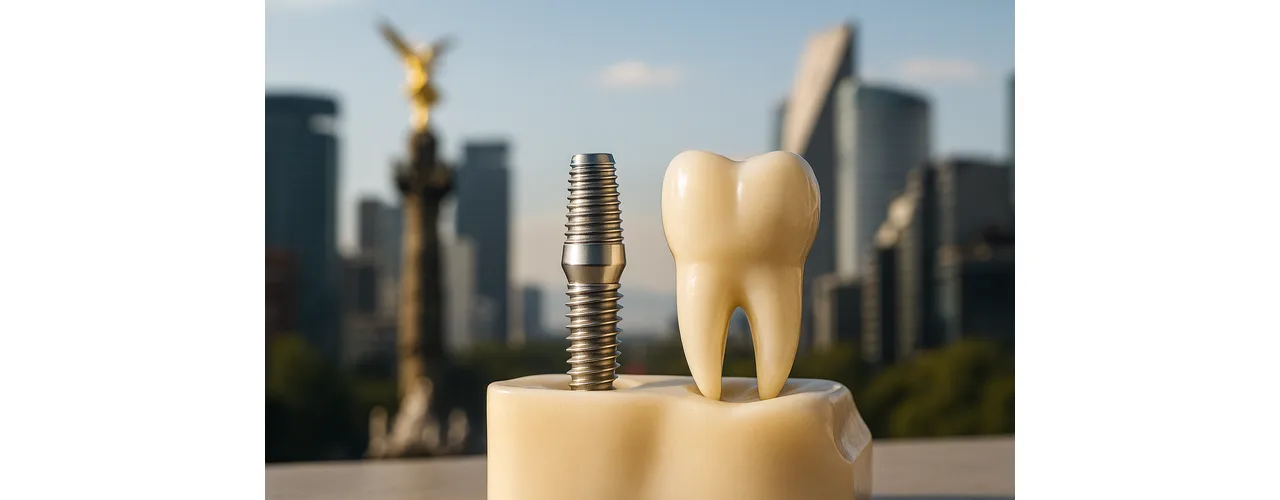
| Single dental implant | $800 - $1,400 |
| Zirconia crown | $300 - $500 |
| All-on-4, per arch | $7,500 - $12,000 |
For everything else, use the gap rather than guessing: take what the procedure cost you at home and cut it by roughly half to two thirds. Then ask your chosen clinic for its current price list, because published lists are common here and the exchange rate moves the dollar figure month to month.
Build the budget in two layers:
- Predictable layer. Routine exams, cleanings and periodic x-rays, typically twice a year. This is small and it is the layer you should never skip, because it is what stops the expensive layer from arriving.
- Contingency layer. One crown, one root canal or one implant in a year is a normal event for a retiree, not a catastrophe. Set aside enough to absorb one of those without flinching, and you have effectively self-insured.
Why recurring-patient math is different from tourist math
A dental tourist optimizes for one trip. Everything gets compressed, priced as a package, and judged on the total including flights. A resident optimizes for two decades. The differences compound:
- No travel cost per visit. Most residents do not need a car to get to the dentist, and the clinics are concentrated on the same north-shore corridor as everything else.
- Staged treatment stops being a problem. Implants take months of healing. A visitor pays for a second trip. You drive over on a Tuesday.
- Prevention becomes economically rational. When a cleaning is a short errand rather than an international journey, you actually go, and the twice-yearly habit is what keeps the contingency layer from firing.
- You build a real clinical record. One dentist watching the same mouth for ten years catches things earlier than a series of strangers reading a fresh x-ray each time.
- Complications are cheap to fix. The high-stress scenario in dental tourism is a problem appearing after you fly home. Living here, that scenario is an appointment.
Practical money details
- Get an itemized receipt every time, even for a cleaning. It costs nothing and it is the only thing that makes a reimbursement claim possible later.
- Ask whether the price quoted includes tax and what payment methods are accepted. Card payments sometimes carry a surcharge.
- Quotes given in dollars are conversions. Ask for the peso figure and the date, especially on a treatment plan spanning months.
- Avoid paying a large multi-stage treatment entirely up front. Staged payment tied to completed stages protects both sides.
What to do about work you already have
Bring your records. Recent x-rays, a list of what has been done and when, and any implant or prosthesis documentation you were given. A dentist who knows which system is already in your mouth can order matching components instead of guessing. This is the single most useful thing you can pack.
The honest caveats
Lower prices do not remove clinical risk. No dentist anywhere can guarantee an outcome, work sometimes has to be redone, and a warranty is only as good as what it says in writing. Choose on verification and fit rather than on the lowest number, and budget for the possibility that a treatment needs a second attempt.
About Molar City
We are an independent dental tourism directory since 2007, tracking 71 clinics around Ajijic, Chapala, Riberas del Pilar, San Antonio Tlayacapan and Jocotepec. We are not a dental clinic and we do not practice dentistry, and no clinic can pay for its position in our ranking.